That under-sink cabinet or cluttered countertop is your last frontier for serious home water quality, and the difference between a mediocre sip and genuine purity comes down to understanding the filtration mechanics that really matter. A well-chosen system eliminates the chore of lugging plastic bottles while delivering a taste that makes tap water feel like a premium resource.
I’m Mohammad Maruf — the founder and writer behind AirfryerBite. I’ve spent the last several years analyzing water filtration hardware specs, studying flow rates, filter life cycles, and certification standards to separate marketing claims from real performance.
Whether you are outfitting a whole house or simply upgrading your kitchen drinking water, finding the right best filtered water system means matching your home’s water chemistry and installation space to a system built for long-term reliability.
How To Choose The Best Filtered Water System
A filtered water system is not a one-size-fits-all purchase. The right choice hinges on your home’s water source (municipal vs well), the specific contaminants you need reduced, and whether you want point-of-use or whole-house coverage. Below are the three critical distinctions that define the category.
Filtration Stage Count And Media Type
More stages do not automatically mean better water, but the type of media in each stage matters deeply. Sediment filters (5 micron or finer) catch rust and silt. Carbon block or GAC (granular activated carbon) reduces chlorine, taste, and odor. KDF media targets heavy metals like lead and iron. Ultrafiltration (UF) membranes with 0.01μm pores block bacteria and cysts. Reverse osmosis (RO) membranes at 0.0001μm remove dissolved solids (TDS). A well-designed system layers these media to match your specific water profile.
Installation Type And Space Constraints
Under-sink systems require cabinet clearance and supply line access, while countertop gravity units need only a flat surface and no plumbing. Whole house systems demand a main water line connection and adequate wall space for filter housings. Tankless RO units save under-sink space but may require a dedicated faucet hole. Gravity-fed countertop systems with stainless steel housings work well for renters or those who want zero electrical dependency.
Certification And True Contaminant Reduction
Look for systems certified by NSF/ANSI Standard 42 (aesthetic chlorine/taste reduction), Standard 53 (health-related contaminant reduction like lead and VOCs), or Standard 58 (reverse osmosis performance). WQA Gold Seal certification adds another layer of independent verification. Avoid systems that claim broad contaminant removal without listing specific third-party test data for the micron rating certified.
Quick Comparison
On smaller screens, swipe sideways to see the full table.
| Model | Category | Best For | Key Spec | Amazon |
|---|---|---|---|---|
| Waterdrop G3P800 | Under Sink RO | High-capacity TDS reduction | 800 GPD, 10-stage, tankless | Amazon |
| Bluevua RO100ROPOT-Lite | Countertop RO | No-install RO + remineralization | 7-stage, UV, 3:1 drain ratio | Amazon |
| Brondell Coral UC300 | Under Sink | PFAS/lead reduction with designer faucet | 3-stage, 600 gal, WQA Gold Seal | Amazon |
| iSpring WGB32B | Whole House | High-flow whole house chlorine removal | 20×4.5″ filters, 15 GPM | Amazon |
| PRO+AQUA PRO-100-E | Whole House | City & well water with pressure gauges | 1″ ports, 100,000 gal capacity | Amazon |
| iSpring WCB32C-KS | Whole House | Heavy metals + PFAS reduction | 3-stage, 30,000 gal, GAC/KDF | Amazon |
| Waterdrop TST-UF | Under Sink UF | No-drill 0.01μm ultrafiltration | 1.59 GPM, 304 stainless steel | Amazon |
| Purewell 2.25G Gravity | Countertop Gravity | No-power, 0.01μm filtration | 2.25 gal, 6000 gal filter life | Amazon |
| Express Water Whole House | Whole House | Entry-level whole house heavy metal reduction | 4.5×20″, KDF + carbon block | Amazon |
In‑Depth Reviews
1. Waterdrop G3P800 Reverse Osmosis System
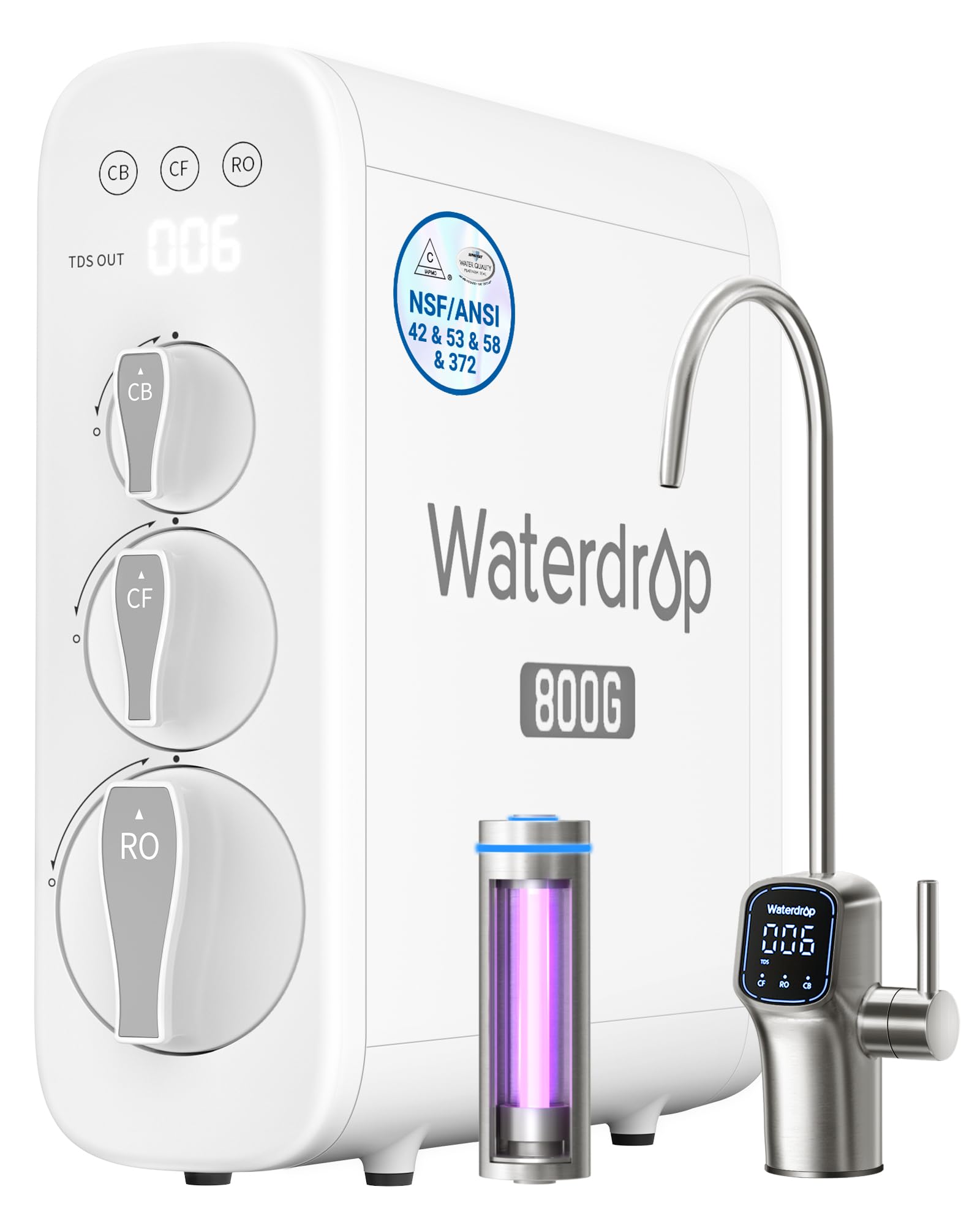
The Waterdrop G3P800 delivers an 800 gallon-per-day capacity that keeps up with heavy household demand, and its tankless design frees up under-sink cabinet space while eliminating the risk of bacterial growth inside a storage tank. With 10 stages of filtration including a reverse osmosis membrane, it reduces PFAS, fluoride, lead, chromium, and other dissolved solids that escape standard carbon filters.
IAPMO certification against NSF/ANSI 58 for TDS reduction gives you verifiable performance data, and the 3:1 pure-to-drain ratio is efficient for a system in this flow class. The smart faucet with an integrated LED display shows real-time TDS levels and filter life, so you are never guessing when to swap cartridges.
Be aware that installation requires two drilled holes — one for the dedicated RO faucet and one for the drain line connection. This system is built for homeowners who want premium TDS reduction without the bulk of a traditional tank-based RO unit.
Why it’s great
- High 800 GPD flow fills a cup in about 5 seconds
- 10-stage filtration with NSF 58 certification for TDS reduction
- Smart faucet LED provides real-time water quality feedback
- 3:1 pure-to-drain ratio reduces wastewater
Good to know
- Requires drilling two holes for installation
- Higher upfront investment compared to carbon-only systems
- Filter replacement cost should be factored into long-term budget
2. Bluevua RO100ROPOT-Lite Countertop Reverse Osmosis
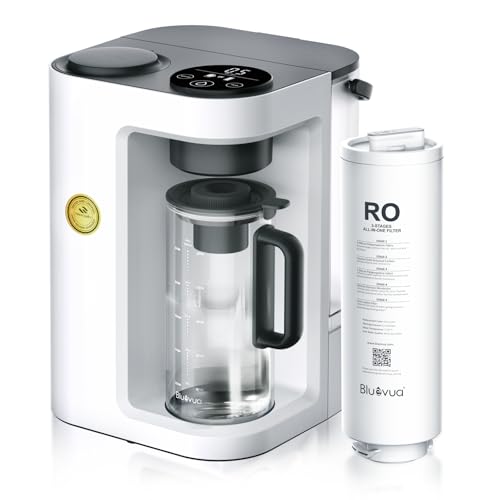
The Bluevua RO100ROPOT-Lite is a plug-and-play countertop RO system that requires zero permanent plumbing, making it ideal for renters or anyone who wants bottled-water quality without a installation project. Its 7-stage filtration chain includes a 5-in-1 composite filter, a UV sterilization stage, and a remineralization filter that adds calcium and magnesium back into the water for a balanced taste profile.
The borosilicate glass carafe with a fruit infuser attachment is a thoughtful design touch that encourages hydration tracking. The smart LED control panel lets you select water volume and displays real-time water quality status, while the 3:1 pure-to-drain ratio keeps wastewater manageable for a countertop unit.
WQA certification against NSF/ANSI 372 for lead-free materials and SGS testing support its purity claims. Filter changes happen just once a year, and the twist-to-install design takes about three seconds. The system is best suited for households of one to two people given its 1.2-liter carafe capacity.
Why it’s great
- No plumbing or drilling required — true plug-and-play setup
- UV sterilization plus remineralization for taste and safety
- Borosilicate glass carafe avoids plastic contamination
- Annual filter replacement simplifies maintenance
Good to know
- Carafe capacity limits batch size to about 1.2 liters
- Flow rate is slower than under-sink RO systems
- Requires counter space and access to a power outlet
3. Brondell Coral UC300 Under Sink Water Filtration

The Brondell Coral UC300 uses a three-stage filtration sequence — sediment, pre-carbon, and carbon block — to target PFAS, lead, chlorine, and other contaminants while leaving beneficial minerals intact. It is WQA Gold Seal certified against NSF/ANSI standards 42, 53, and 372, and also meets CSA B483.1 for lead reduction, giving you a strong third-party validation chain.
The included designer chrome faucet with an integrated LED filter change indicator eliminates guesswork about when to replace cartridges. The Twist & Seal filter change system is genuinely tool-free, and the twin quick-connect hoses streamline installation under the sink.
Each filter set lasts up to 12 months or 600 gallons, making it a mid-cycle maintenance product for households that want reliable contaminant reduction without the complexity of a multi-stage RO system. It does not reduce TDS, so if dissolved solids are your primary concern, this is not the right pick.
Why it’s great
- WQA Gold Seal certified for lead, chlorine, and PFAS reduction
- LED indicator on the faucet alerts you to filter changes
- Easy Twist & Seal filter swap with no tools required
- Designer chrome faucet matches modern kitchen aesthetics
Good to know
- Does not reduce TDS or remove dissolved solids
- 600-gallon filter life may require changes more often in high-use households
- Faucet finish requires periodic cleaning to maintain appearance
4. iSpring WGB32B Whole House Water Filter System

The iSpring WGB32B is a three-stage whole house system using 20-inch by 4.5-inch industrial-standard filters — a 5-micron sediment stage followed by two CTO carbon block stages using coconut shell carbon. It eliminates up to 99% of chlorine, sediment, rust, and associated tastes and odors across every tap in the home.
The 1-inch NPT inlet and outlet maintain a flow rate up to 15 gallons per minute, which means you can run a shower and a kitchen faucet simultaneously without noticeable pressure drop. The system uses individually wrapped cartridges that stay fresh until installation, and the clear first-stage housing lets you visually inspect sediment buildup.
iSpring provides a lifetime of free technical support from their US-based team, and registering online activates an extended warranty. The system is not designed for TDS reduction, so if you need dissolved solids removal, they recommend pairing it with one of their under-sink RO units.
Why it’s great
- High 15 GPM flow rate supports simultaneous multi-appliance use
- 20×4.5-inch filters offer long service life and high sediment capacity
- Coconut shell carbon provides effective chlorine and taste reduction
- Lifetime tech support and extended warranty available via registration
Good to know
- Large housing size requires adequate wall space for installation
- No TDS reduction — retains minerals but does not soften water
- Individually wrapped filters must be unwrapped before use
5. PRO+AQUA Elite Series GEN2 PRO-100-E
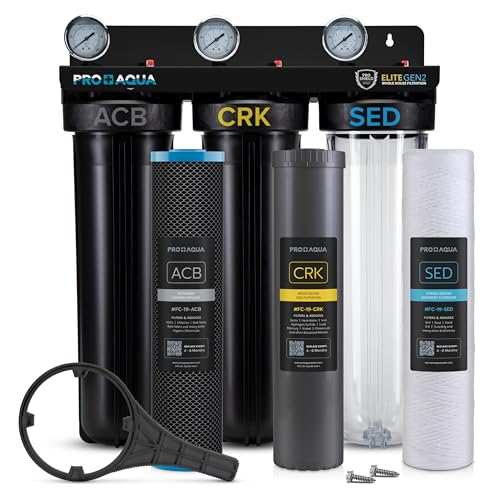
The PRO+AQUA Elite Series GEN2 PRO-100-E is a professional-grade three-stage whole house system built for both city and well water applications. Stage 1 uses a clear housing sediment filter to catch rust and silt, Stage 2 employs a proprietary CRK media blend targeting heavy metals like lead and iron plus hydrogen sulfide odors, and Stage 3 deploys activated coconut shell carbon to remove chlorine, VOCs, and pesticides.
Stainless steel pressure gauges on the inlet and outlet let you monitor the system’s health and know exactly when differential pressure signals a clogged filter. With 1-inch ports and a maximum flow rate of 15 gallons per minute, it handles households with 1-3 bathrooms without noticeable pressure loss.
The system requires no electricity, backwash, or drain, making it a passive filtration solution. PRO+AQUA backs it with a five-year manufacturer warranty (upon registration) and free lifetime US-based tech support. Filter replacements are recommended every six months for optimal performance.
Why it’s great
- CRK media targets heavy metals and hydrogen sulfide odor
- Stainless steel pressure gauges enable real-time system monitoring
- No electricity or backwash required for operation
- Five-year warranty and lifetime tech support included
Good to know
- Heavier unit at 50 pounds requires secure wall mounting
- Professional installation recommended for best results
- Filters need replacement every 6 months regardless of water quality
6. iSpring WCB32C-KS Whole House Filter System

The iSpring WCB32C-KS is a three-stage whole house system that combines a 5-micron PP sediment filter with a GAC and KDF composite second stage and a CTO carbon block third stage. The GAC/KDF composite is the standout feature here — it effectively reduces PFAS, lead, radon, chloramine, and hydrogen sulfide, which are common concerns for municipal and well water alike.
The transparent first-stage housing lets you visually inspect the sediment filter, making it easy to know when a change is needed before the downstream stages get overloaded. Designed for a family of four, it has a 30,000-gallon capacity with filters recommended for replacement every six months.
Installation is DIY-friendly with a detailed manual and video guide, and iSpring offers lifetime free technical support from their US-based team. Like other whole house systems in this class, it does not reduce TDS, so if that is a priority, you would need to pair it with an under-sink RO unit.
Why it’s great
- GAC and KDF composite targets PFAS and heavy metals effectively
- Transparent first-stage housing allows easy filter condition checks
- 30,000-gallon capacity designed for a family of four
- Lifetime tech support and extended warranty with registration
Good to know
- No TDS reduction — retains minerals
- Filters require replacement every six months
- Wall-mount installation requires adequate clearance
7. Waterdrop TST-UF Under Sink Water Filter

The Waterdrop TST-UF uses a 0.01-micron ultrafiltration membrane that blocks bacteria, cysts, and sediment particles while letting beneficial minerals pass through. The housing is made from lead-free 304 stainless steel, which is a significant upgrade over plastic housings in terms of durability and leak resistance.
Installation requires no drilling — it connects directly to a 3/8-inch or 1/2-inch cold water supply line with the included fittings. The system supports a flow rate of 1.59 gallons per minute, filling an 8-ounce cup in about 2.3 seconds. Multiple arrangement options let you hang it on the cabinet wall or place it on the floor.
The three-filter set has staggered lifespans: the PP sediment filter lasts 6-8 months, the UF membrane lasts 12 months, and the CT carbon filter lasts 12-24 months. This system is designed specifically for municipal tap water and cannot be used with well water or hot water sources.
Why it’s great
- 0.01μm ultrafiltration membrane blocks bacteria and cysts
- Lead-free 304 stainless steel housing for durability
- No-drill installation connects directly to standard supply lines
- Quick 1.59 GPM flow rate
Good to know
- Does not reduce TDS — retains minerals
- Not suitable for well water or hot water sources
- Requires 3/8″ or 1/2″ female NPT thread faucet connection
8. Purewell 2.25G Gravity Water Filter System

The Purewell 2.25G is a gravity-fed countertop filtration system that operates without electricity, making it a strong choice for off-grid use, emergency preparedness, or just anyone who wants to avoid plumbing modifications. Its 0.01-micron hollow fiber UF membrane, combined with a silver ion membrane and activated carbon block, reduces 99% of chlorine along with rust, sediment, organic matter, and heavy metals.
The transparent water level window on the upper chamber lets you see exactly how much unfiltered water remains, eliminating the guesswork of when to refill. The stainless steel body and included stand give it a stable, kitchen-friendly footprint. Each black carbon filter provides up to 3,000 gallons of filtration, so the pair included yields 6,000 gallons total before replacement.
Purewell recommends replacing filter elements every six months for optimal performance. Note that this system does not reduce TDS — it is designed for municipal tap water and works best as a taste and sediment improvement solution for households that prefer zero-energy filtration.
Why it’s great
- No electricity required — gravity filtration works off-grid
- 0.01μm UF membrane blocks 99.99% of microscopic contaminants
- Transparent water level window for easy monitoring
- 6000 gallons total filter life from the included pair
Good to know
- Flow rate is slower than pressurized systems at 4 gallons per hour
- Does not reduce TDS
- Stainless steel body requires periodic cleaning to maintain appearance
9. Express Water Whole House Heavy Metal Water Filter Set

The Express Water Whole House Heavy Metal Filter Set is a three-stage system using 4.5-inch by 20-inch standard-size cartridges: a sediment filter, a KDF heavy metal filter, and a carbon block filter. The KDF stage uses high-purity copper and zinc granules to reduce heavy metals including iron, lead, nickel, and chromium through an ion exchange process.
The system is designed for installation at the main water supply line and delivers up to 100,000 gallons of filtration depending on incoming water quality. It is important to note that this is a whole house system designed for sediment and chemical reduction, not for reducing total dissolved solids — Express Water explicitly states that their RO systems handle TDS removal.
Standard 4.5×20-inch cartridges are widely available and easy to replace, and the system helps extend the life of appliances like dishwashers and water heaters by removing sediment and scale-forming particles. Support is available from Express Water’s customer service team for installation and troubleshooting questions.
Why it’s great
- KDF media reduces heavy metals like lead, iron, and chromium
- 100,000-gallon capacity provides long filter life
- Standard 4.5×20-inch cartridges are easy to find and replace
- Extends the lifespan of household appliances by removing sediment
Good to know
- Does not reduce TDS — not a replacement for RO systems
- Installation requires main water line access
- Filter life depends on incoming water quality conditions
FAQ
Does a filtered water system remove fluoride and lead?
Can I install a filtered water system myself or should I hire a plumber?
What is the difference between a whole house system and an under sink system?
How often should I replace the filters in my filtered water system?
Final Thoughts: The Verdict
For most users, the best filtered water system winner is the Waterdrop G3P800 because it delivers 800 GPD flow with NSF-certified TDS reduction and a tankless smart faucet design. If you want zero-installation countertop RO with remineralization, grab the Bluevua RO100ROPOT-Lite. And for whole house coverage with heavy metal reduction and pressure monitoring, nothing beats the PRO+AQUA Elite Series PRO-100-E.