The difference between a mediocre shot and a great one comes down to temperature stability, consistent pressure, and the skill of the person pulling the shot. A semi automatic espresso machine puts you in control of grind, dose, tamp, and extraction time, rewarding attention to detail with a thick, golden crema that super-automatic machines rarely achieve.
I’m Mohammad Maruf — the founder and writer behind AirfryerBite. I’ve spent months researching pump pressure curves, portafilter sizes, PID temperature control systems, and steam wand performance across dozens of models to identify which machines deliver consistent results without demanding a second mortgage.
This guide focuses on machines that balance manual control with helpful automation, so you can develop your barista skills without fighting unreliable hardware. Whether you’re upgrading from a pod system or buying your first prosumer machine, I’ve selected only models that earn their place in the conversation around the best semi automatic espresso machine for your home setup.
How To Choose The Best Semi Automatic Espresso Machine
Choosing a semi-automatic machine means deciding how much control you want over each variable — grind size, dose weight, tamp pressure, and extraction time — versus how much guided assistance you need. The right machine for you depends on your willingness to dial in a grinder and your budget for long-term consistency.
Portafilter Size and Material
The 54mm portafilter is common on entry-level machines, but a 58mm commercial-grade portafilter holds a larger dose (18-22 grams) and provides a wider puck surface for more even water distribution. Stainless steel portafilters with a chrome-plated brass body retain heat better than aluminum alternatives, reducing temperature drop during extraction.
Temperature Stability: PID vs. Thermostat
A PID controller uses a digital chip to maintain water temperature within a fraction of a degree, eliminating the temperature surfing required on thermostat-controlled machines. Without PID, you’ll need to flush water through the group head to stabilize heat between shots — a workflow that quickly becomes tedious during morning rushes.
Boiler Configuration: Single, Heat Exchanger, or Dual
Single-boiler machines switch between brewing and steaming, meaning you wait for the boiler to heat up between functions. Heat exchanger models use one boiler kept at steam temperature while a tube inside provides brew-temperature water, allowing simultaneous brewing and steaming. Dual-boiler machines dedicate one boiler to brew and one to steam, offering the most precise temperature control and fastest workflow for milk-based drinks.
Pump Pressure and OPV Valve
Most machines advertise a 15 or 20-bar pump, but the ideal extraction pressure for espresso is 9 bars at the group head. An Over-Pressure Valve (OPV) regulates that pressure down to the correct range. Without an OPV, you risk channeling and bitter flavors from excessive pressure. A three-way solenoid valve then releases pressure after the shot stops, keeping the puck dry for easy knock-out.
Quick Comparison
On smaller screens, swipe sideways to see the full table.
| Model | Category | Best For | Key Spec | Amazon |
|---|---|---|---|---|
| Breville Barista Touch Impress | Premium | Guided espresso with minimal dial-in | ThermoJet 3-sec heat-up, 30 grind settings | Amazon |
| Breville Dual Boiler BES920XL | Premium | Simultaneous brew and steam at home | Dual stainless boilers, PID +/-2°F | Amazon |
| Rocket Espresso Appartamento Nera | Premium | E61 group heat exchanger on a small footprint | 1.8L heat exchanger, 58 lb weight | Amazon |
| Rancilio Silvia | Mid-Range | Prosumer build quality on a budget | Commercial group head, 30.8 lb steel frame | Amazon |
| Ninja Luxe Café Pro ES701 | Premium | All-in-one espresso, drip, cold brew | Integrated tamper, 25 grind settings | Amazon |
| Chefman Crema Supreme | Mid-Range | Built-in conical burr grinder | 15-bar pump, 3L water tank | Amazon |
| KitchenAid Semi-Automatic KES6403 | Mid-Range | Compact footprint with dual temp sensors | 15-bar pump, 58mm commercial portafilter | Amazon |
| Gevi 20 Bar with 58mm Portafilter | Value | PID control with OPV at entry-level price | PID+NTC dual temp, OPV relief valve | Amazon |
| CASABREWS Ultra with LCD Display | Value | Budget-friendly with adjustable brew temp | 20-bar Italian pump, 73 oz tank | Amazon |
In‑Depth Reviews
1. Breville Barista Touch Impress BES881BSS

The Barista Touch Impress redefines the guided experience in the semi-automatic category by combining intelligent dosing with a 22-pound assisted tamp — a feature that eliminates the most common variable beginners get wrong. The ThermoJet heating system reaches extraction temperature in three seconds, so you are not waiting for the group head to stabilize before pulling a shot. Baratza precision conical burrs with 30 grind settings give you fine control over particle size, and the touchscreen interface provides step-by-step feedback on each stage of puck preparation.
What sets this machine apart is the Impress Puck System, which automatically adjusts the dose based on the previous shot’s result. After you grind and tamp, the machine displays a visual indicator showing whether the puck was under-dosed, over-dosed, or correct, and it modifies the grind time for the next dose accordingly. The Auto MilQ steam wand includes three alternative milk settings that calibrate air injection and temperature for oat, almond, and soy milk, producing microfoam that holds up for latte art without scorching the proteins.
The 67-ounce water tank is generous for daily use, and the integrated storage compartment keeps accessories organized. Some users report the grind calibration drifts over several weeks, requiring periodic re-dialing, and the assisted tamp lever adds a mechanical component that may need maintenance over the machine’s lifespan. For anyone who wants café-quality consistency without the steep learning curve of a commercial-grade machine, this is the most complete package available.
Why it’s great
- ThermoJet heats in 3 seconds, no warm-up wait
- Intelligent dose adjustment reduces puck waste
- Auto MilQ settings for alternative milks produce consistent microfoam
Good to know
- Grind setting may drift and require recalibration over time
- Assisted tamp mechanism adds complexity and potential long-term service needs
2. Breville Dual Boiler BES920XL

The Dual Boiler is built for the home barista who wants commercial-level temperature stability without modifying a machine for pressure profiling. Two independent stainless steel boilers — one dedicated to brewing at 200°F and one dedicated to steam — let you pull a shot and steam milk simultaneously without any temperature compromise. The PID controller holds the brew boiler within a two-degree Fahrenheit window, and the heated group head further stabilizes the temperature of the water hitting the puck.
The 58mm portafilter accepts commercial baskets, and the included Razor precision dosing tool trims the puck to the correct headspace, eliminating the need to weigh your dose every time. The over-pressure valve limits maximum pump pressure to prevent over-extraction and channeling, while low-pressure pre-infusion gently expands the grounds before full pressure engages. The LCD display includes a shot timer, and the machine allows manual pre-infusion and volumetric programming for repeatable shots.
One consideration is that the steam boiler is not as powerful as the twin-thermoblock systems on some newer machines, meaning texturing milk for a large pitcher takes a few extra seconds. The plastic housing on the outer shell also feels less premium than the all-metal build of the Rocket or Rancilio options. For anyone who values separate dedicated boilers and a 2-year warranty over flashy design, this machine offers exceptional temperature fidelity at a lower entry point than comparable E61 models.
Why it’s great
- Dual boilers allow simultaneous brewing and steaming
- PID control keeps brew water within 2°F consistently
- Commercial 58mm portafilter accepts standard baskets
Good to know
- Steam boiler power is lower than some newer thermal designs
- External housing is plastic, not stainless steel
3. Rocket Espresso Appartamento Nera

Rocket’s Appartamento Nera brings Italian E61 group head engineering to a compact footprint that fits under standard upper cabinets without sacrificing heat exchanger performance. The 1.8-liter heat exchanger boiler maintains steam pressure for continuous milk texturing while simultaneously delivering brew-temperature water through the E61 thermosiphon design, which circulates water through the group head to keep it warm and stable. The black powder-coated body with white side panels offers a distinctive aesthetic that stands apart from brushed stainless steel options.
The commercial-grade brass group head and copper boiler provide excellent thermal mass, and the mechanical steam and brew controls give you full manual authority over every aspect of the shot. The articulating steam wand with a two-hole tip produces the kind of microfoam that experienced baristas prefer for latte art, and the three-year warranty on parts and labor is the best in this class. The machine ships with both single and double spouted portafilters, a stainless steel tamper, and a blind basket for backflushing.
The 58-pound weight means this machine is not portable, and you will need to let the E61 group head warm up for 20-30 minutes before pulling a temperature-stable shot — a non-issue if you use a smart plug with a timer. The drip tray grille is polished chrome, which shows water spots quickly, and the water reservoir holds only 61 ounces, which may require refilling after four to five doubles. For the enthusiast who wants commercial build quality and repairability in a home-sized package, the Appartamento Nera delivers timeless Italian engineering.
Why it’s great
- E61 group head provides excellent thermal stability once warm
- Heat exchanger allows simultaneous brew and steam
- Three-year parts and labor warranty is best in class
Good to know
- Requires 20-30 minute warm-up before first shot
- 61 oz water tank is smaller than most competitors
4. Rancilio Silvia Espresso Machine

The Rancilio Silvia has been a benchmark in the entry-level prosumer category for years, and for good reason. It uses the same commercial-grade brass group head found on Rancilio’s larger café machines, paired with an iron frame and stainless steel side panels that give it a solid, vibration-free feel during extraction. The 10-ounce boiler is on the smaller side, but the brass construction and heavy thermal mass help maintain temperature stability once it reaches equilibrium.
The articulating steam wand with a professional steaming knob provides a full range of motion, and the two-hole tip produces decent microfoam once you dial in the technique. The Silvia does not include a PID controller out of the box — temperature is managed by a mechanical thermostat, so you will need to temperature surf by timing your shot after the heating cycle light turns off. This is the trade-off for durability at this price point, and many owners eventually add an aftermarket PID kit.
Water capacity is limited to 10 ounces, so you will refill the reservoir frequently if pulling multiple drinks back-to-back, but the optional pod and capsule adapter kit adds flexibility for quick single servings. The Silvia measures just 9.2 inches deep, making it one of the narrowest machines on this list for tight countertops. If you are willing to learn the timing nuances of a single-boiler thermostat machine, the Silvia will reward you with build quality that lasts fifteen years or more.
Why it’s great
- Commercial brass group head delivers excellent heat stability
- Iron frame and stainless panels for long durability
- Compact depth fits tight counter spaces
Good to know
- Small 10 oz boiler requires temperature surfing
- No PID controller, only mechanical thermostat
5. Ninja Luxe Café Pro ES701

Ninja’s Luxe Café Pro is a four-in-one machine that covers espresso, drip coffee, cold brew, and an independent hot water system, all built around a semi-automatic espresso workflow. The integrated tamper lever eliminates the mess of overflowing grounds — you grind directly into the portafilter, push the lever, and the machine tamps with consistent pressure every time. Barista Assist Technology monitors each brew and adjusts grind-size recommendations for the next shot, which significantly reduces the dial-in learning curve for new users.
The conical burr grinder offers 25 settings, and the built-in scale provides weight-based dosing rather than time-based grinding, so you get the same dose regardless of bean density. The Dual Froth System Pro combines steaming and whisking to create hot or cold microfoam from dairy and plant-based milks, and the XL milk jug handles enough volume for two drinks per cycle. The machine also brews cold-pressed espresso at lower temperature and pressure for a smoother, less acidic flavor profile.
Some experienced baristas note that the crema thickness from the espresso shots is slightly less pronounced than what a dedicated PID-controlled machine produces, and the 27-pound footprint is substantial. The drip coffee and cold brew functions are genuine value-adds, but the primary focus remains the espresso workflow. For households with multiple drink preferences — espresso drinks, drip coffee, and cold brew — this machine eliminates the need for separate appliances while maintaining a guided semi-automatic experience.
Why it’s great
- Integrated tamper lever simplifies puck prep and reduces mess
- Weight-based dosing for consistent dose regardless of bean density
- Combines espresso, drip, and cold brew in one footprint
Good to know
- Espresso crema is less pronounced than dedicated machines
- Large and heavy at 27 pounds, requires dedicated counter space
6. Chefman Crema Supreme

The Chefman Crema Supreme combines a 15-bar pump with a built-in conical burr grinder that offers 30 grind settings, letting you grind fresh directly into the 58mm portafilter before brewing. The pressure gauge on the front panel displays pump pressure during extraction, which helps you diagnose whether your grind is too fine or too coarse without guessing. The machine includes both single and double shot baskets, and the programmable shot volume and temperature settings give you control over the final cup profile.
The 3-liter removable water tank is one of the largest in this category, supporting multiple back-to-back shots without refilling. The integrated milk steam wand produces adequate microfoam for cappuccinos and lattes, and the included milk pitcher, tamper, and cleaning tools add value out of the box. The machine measures 16 inches in height and 13 inches wide, which is comparable to other machines with built-in grinders but still manageable for most countertops.
One point to note is that the grinder is a conical burr design, which is generally preferable to blade grinders for consistency, but it is not stepless — you have discrete click settings rather than infinite adjustment. The machine also lacks PID temperature control, relying on a standard thermostat for temperature regulation, so you may notice some temperature drift during back-to-back extractions. For the price point that includes a grinder, pressure gauge, and large tank, this is one of the most feature-dense semi-automatic options available.
Why it’s great
- Built-in conical burr grinder with 30 settings for fresh grinding
- Pressure gauge display helps dial in grind size visually
- 3-liter water tank handles multiple drinks without refilling
Good to know
- No PID control, standard thermostat may drift
- Grinder is click-stop rather than stepless for fine adjustment
7. KitchenAid Semi-Automatic KES6403

KitchenAid’s semi-automatic machine stands out for its slim profile — only 6.38 inches deep — which makes it one of the few espresso machines that fits on a narrow countertop between the backsplash and the edge of the cabinet. Despite the compact footprint, it uses a 58mm commercial-grade portafilter, giving you access to standard accessories and baskets. Dual smart temperature sensors monitor brew and steam temperatures independently, helping maintain consistency without a full PID system.
The 15-bar Italian pump provides sufficient pressure for proper extraction, and the steam wand with a two-hole tip produces microfoam suitable for latte art with some practice. The machine comes with four filter baskets — single and double in both pressurized and non-pressurized configurations — which allows you to start with the easier pressurized baskets and graduate to the non-pressurized ones as your technique improves. The 1.4-liter water tank is small but acceptable for a machine that targets single-drink households.
The plastic housing does not feel as premium as the stainless steel options from Breville or Rancilio, and the steam wand is articulated but operates with a simple switch rather than a professional steam knob. The water tank is rear-mounted, which requires pulling the machine forward for refills. For apartment dwellers or anyone working with limited counter depth, this machine delivers commercial portafilter compatibility in a footprint no wider than a toaster.
Why it’s great
- Ultra-slim 6.38 inch depth fits tight counters
- 58mm commercial portafilter with four basket options
- Dual temp sensors improve consistency for the category
Good to know
- Plastic outer housing feels less premium
- Water tank is rear-mounted, requires moving machine to refill
8. Gevi 20 Bar with 58mm Portafilter
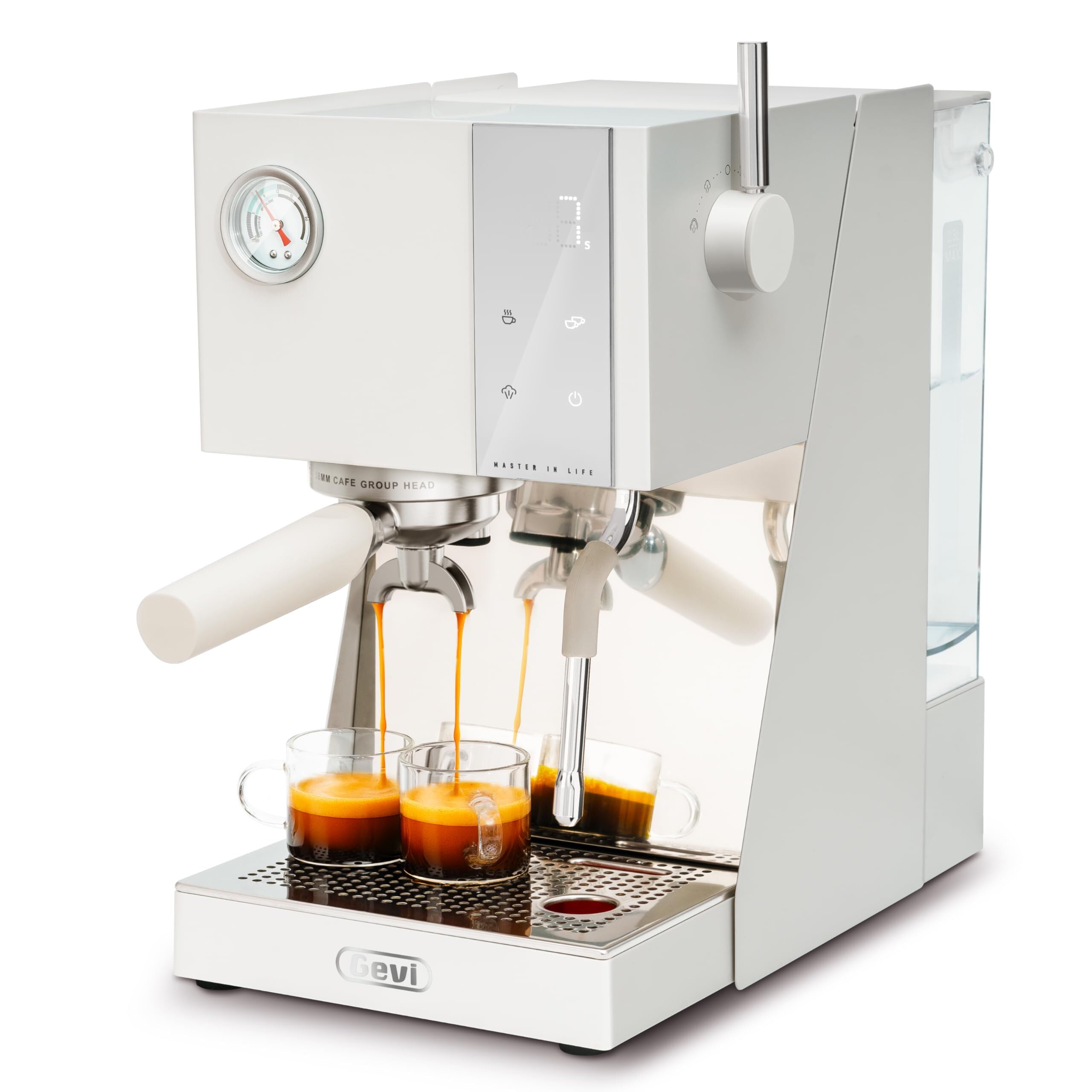
The Gevi 20 Bar machine brings features normally reserved for machines costing twice as much — PID+NTC dual temperature control, an OPV pressure relief valve, and a three-way solenoid valve — all built around a 58mm commercial portafilter. The PID system lets you select between 92°C, 94°C, and 96°C brew temperatures, giving you the ability to adjust for light or dark roasts without temperature surfing. The OPV ensures the pump pressure does not exceed the 9-12 bar sweet spot for optimal extraction.
The real-time touch display shows the shot timer, current temperature, and pump pressure, providing visual feedback as you dial in your grind. The 2.3-liter detachable water tank is easy to fill and holds enough for several drinks, and the professional steam wand produces silky microfoam that customers consistently praise for latte art. The 21.6-pound weight reflects the stainless steel construction, and the machine includes a full accessory package with a stainless steel milk pitcher, cleaning tools, and a tamper.
Some users report that the included portafilter is slightly short in handle length compared to standard aftermarket options, which may require using the included baskets rather than upgrading. The steam boiler takes about 45 seconds to reach full power after brewing, so you cannot steam immediately after pulling a shot. For a budget-friendly price point that includes PID, OPV, and a solenoid valve, this machine offers an exceptional feature-to-price ratio for anyone serious about espresso but not ready to invest in premium hardware.
Why it’s great
- PID+NTC temperature control with three presets
- OPV valve and 3-way solenoid for dry pucks
- Stainless steel build with 2.3L water tank
Good to know
- Portafilter handle is shorter than standard aftermarket options
- Steam boiler requires ~45 second recovery between brew and steam
9. CASABREWS Ultra with LCD Display

The CASABREWS Ultra is the most accessible entry point on this list, offering a 20-bar Italian pump and an LCD display that guides you through steam, hot water, and pre-programmed shot modes. The 1350-watt boiler provides sufficient thermal energy for a 20-bar pump that, while exceeding the 9-bar extraction sweet spot, still produces respectable crema with the right grind and tamp. The adjustable brewing temperature feature offers four settings that let you compensate for different roast levels, though it only applies to the brewing cycle, not the steam wand.
The steam wand produces enough pressure for milk frothing, but the microfoam quality is more suited to simple cappuccinos and lattes than detailed latte art. The 73-ounce water tank is generous for this category, and the brushed stainless steel finish looks clean on any counter. The portafilter is a pressurized 58mm design, which helps create artificial pressure for consistent results without requiring a fine grind — a clear advantage for beginners who are still learning to dial in.
The machine operates with basic tactile buttons rather than a touchscreen or programmable shot volumes, meaning you control shot length manually by pressing the brew button on and off. The included accessory kit is minimal — a single cleaning needle and two filter baskets — so you will want to purchase a tamper and milk pitcher separately. For someone on a tight budget who wants to enter the semi-automatic world with a pressurized portafilter and adjustable temperature, the CASABREWS Ultra represents the lowest-cost path to learning the basics.
Why it’s great
- 20-bar Italian pump at an accessible entry price
- Four adjustable brew temperature settings
- Large 73 oz water tank reduces refills
Good to know
- Pressurized portafilter limits upgrade potential
- Manual shot control with tactile buttons, no volumetric programming
FAQ
What is the ideal pump pressure for a semi automatic espresso machine?
Do I need a 58mm portafilter to make good espresso?
Is a dual boiler better than a heat exchanger for home use?
Final Thoughts: The Verdict
For most users, the best semi automatic espresso machine winner is the Breville Barista Touch Impress because it combines intelligent dose correction, fast heat-up, and hands-free microfoam in a package that shortens the dial-in process dramatically. If you want simultaneous brew-and-steam capability with rock-solid PID control, grab the Breville Dual Boiler BES920XL. And for commercial-grade E61 engineering on a compact chassis, nothing beats the Rocket Espresso Appartamento Nera.