A cost-effective water filter should remove harmful contaminants without adding a monthly subscription fee that rivals your phone bill. Finding the sweet spot between low upfront cost, filter longevity, and actual contaminant reduction is the real challenge in this category.
I’m Mohammad Maruf — the founder and writer behind AirfryerBite. I’ve spent years analyzing filtration hardware, certification standards, and consumer tap-water testing data to separate marketing fluff from genuine performance.
After reviewing dozens of models across price tiers, I’ve narrowed the field to a shortlist that delivers clean drinking water without straining your budget. This guide will help you find the best inexpensive water filter for your home and refill habits.
How To Choose The Best Inexpensive Water Filter
Not all budget filters reduce the same contaminants. The cheapest option on the shelf might look appealing, but a filter that doesn’t address your local water quality is just a plastic pitcher. Focus on three things: certified reduction claims, total filter life in gallons, and BPA-free construction.
Certification Matters More Than Branding
Look for NSF/ANSI Standard 42 (for taste and odor) and Standard 53 (for health contaminants like lead and mercury). Some filters also carry IAPMO certification. These independent marks validate that the filter actually removes what it claims. A filter without certification is a guess, not a guarantee.
Check Filter Life in Gallons, Not Months
Manufacturers often advertise “lasts two months” based on average household usage. If your household drinks more water, that same filter might need changing every four weeks. Always cross-reference the gallon rating — 40 gallons is typical for standard filters, while longer-life options reach 120 gallons or more.
Capacity vs. Counter Space
A 10-cup pitcher fits easily on a fridge shelf but requires more frequent refills. A 30-cup dispenser stays on the countertop and serves a larger family. Measure your available space and average daily consumption before deciding between a pitcher and a dispenser.
Quick Comparison
On smaller screens, swipe sideways to see the full table.
| Model | Category | Best For | Key Spec | Amazon |
|---|---|---|---|---|
| Zerowater 5-Stage 2-Pack | Replacement Filter | Zero TDS / Purest Taste | 5-Stage Ion Exchange | Amazon |
| Brita Plus 4-Pack | Replacement Filter | High Density / 2x Contaminants | 40-Gallon Filter Life | Amazon |
| Brita Large 10-Cup Pitcher | Pitcher + Filter | Fridge-Friendly Pitcher | 10-Cup Capacity | Amazon |
| PUR 30-Cup Dispenser | Countertop Dispenser | Large Family / High Volume | 30-Cup / 7.09 Liter Capacity | Amazon |
| Amazon Basics 10-Cup Pitcher | Pitcher + Filter | Budget Entry Point | WQA & NSF Certified | Amazon |
In‑Depth Reviews
1. Zerowater Official Replacement Filter – 5-Stage 0 TDS, 2-Pack

This is the closest you get to distilled-level purity without a plumber. The Zerowater 5-Stage Ion Exchange filter removes virtually all Total Dissolved Solids (TDS), which means your water ends up with a reading near zero on the TDS meter. For anyone dealing with hard water, metallic aftertaste, or concerns about PFOA/PFOS contamination, this filtration depth is unmatched at this price tier. The included pack contains two filters, each rated for about 15 gallons — shorter life than carbon-only filters, but the trade-off is dramatically cleaner water.
The filter is IAPMO certified to reduce lead, chromium, and mercury, and the entire unit is built from BPA-free plastic. It’s compatible with the full Zerowater pitcher and dispenser line. Keep in mind that the 15-gallon filter life means you’ll replace it more frequently — about once a month for a family of two. The TDS meter that comes with most Zerowater systems takes the guesswork out of timing your replacements.
If you believe “pure” water should have no dissolved solids, this is your filter. It’s especially valuable for coffee and tea drinkers who notice the difference that near-zero mineral content makes in flavor extraction. The 2-pack helps offset the shorter filter life, keeping the per-filter cost manageable.
Why it’s great
- Removes virtually all dissolved solids for the purest possible taste.
- IAPMO certified to reduce lead, chromium, PFOA/PFOS, and mercury.
- BPA-Free construction with Ion Exchange technology for deep filtration.
Good to know
- 15-gallon filter life is shorter than standard carbon filters.
- Only compatible with Zerowater brand pitchers and dispensers.
- Requires a TDS meter (included with many Zerowater systems) to know when to replace.
2. Brita Plus Water Filter, BPA-Free, 4-Pack
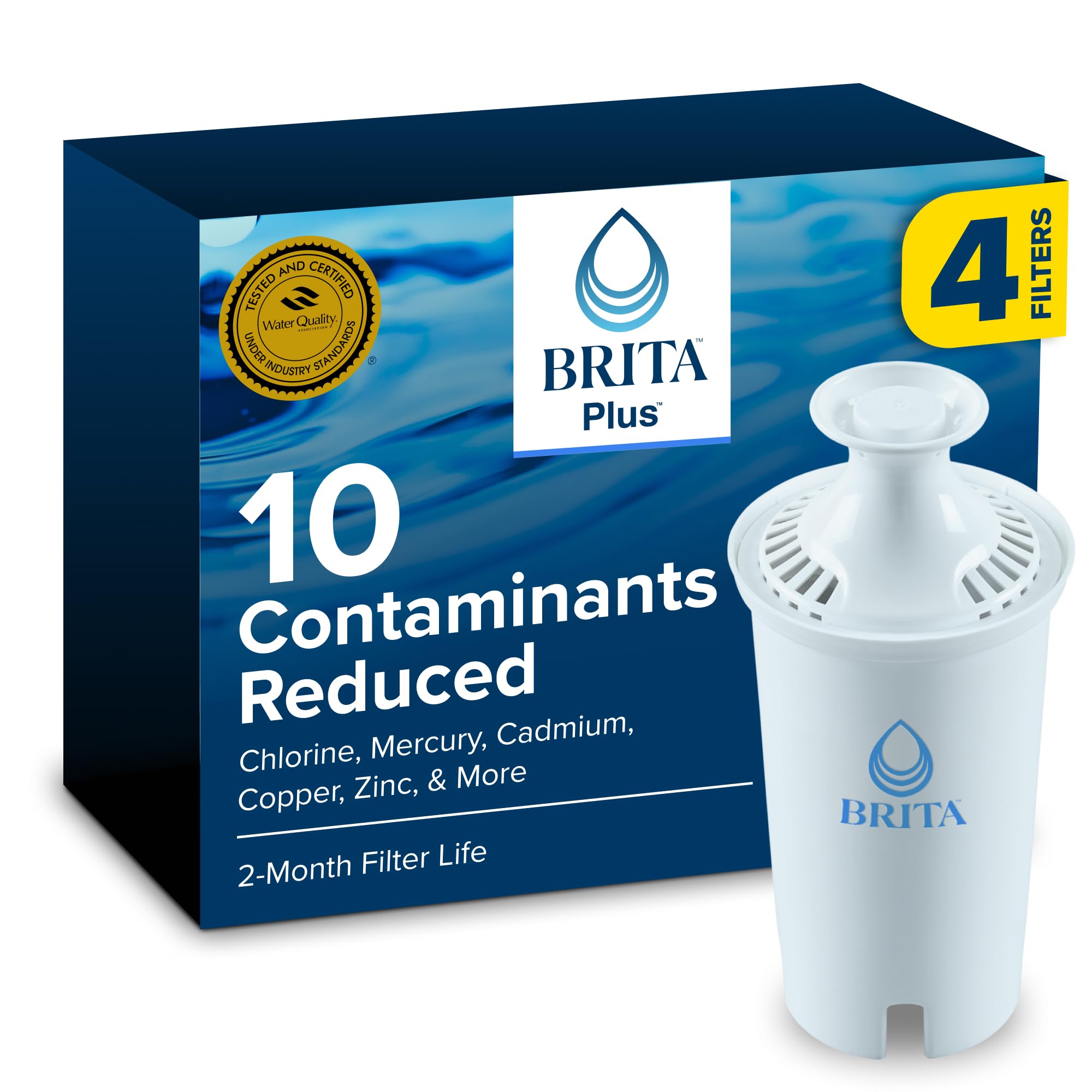
The Brita Plus filter uses a high-density weave that traps twice as many contaminants as the standard Brita filter. For households already using a Brita pitcher, this is a direct upgrade that costs nearly the same per filter as the standard version. It still reduces chlorine for improved taste and odor, but the denser media also catches more sediment and microscopic particles that standard filters may allow through.
Each filter lasts 40 gallons or approximately two months, which aligns with typical household usage of about 11 glasses per day. The 4-pack provides eight months of filtration, so you aren’t ordering replacements every cycle. It’s compatible with all Brita systems except the Stream line, which means it works with pitchers and dispensers you may already own. The BPA-free construction and NSF certification give it a solid reliability baseline.
If you want improved filtration without switching to a completely different filter platform, this is the easiest swap. The higher density media doesn’t noticeably slow the flow rate, so you won’t be waiting longer for your pitcher to fill. For buyers who prioritize proven performance and brand consistency, the Brita Plus 4-pack is a smart mid-cycle upgrade.
Why it’s great
- Traps twice as many contaminants as standard Brita filters.
- Lasts 40 gallons or 2 months per filter; 4-pack covers 8 months.
- BPA-Free and NSF certified for reliable, tastier water.
Good to know
- Not compatible with Brita Stream systems.
- Does not reduce TDS or dissolved solids like ion-exchange filters.
- Primarily targets chlorine taste, odor, and select heavy metals.
3. Brita Large Water Filter Pitcher, 10-Cup, Bright White
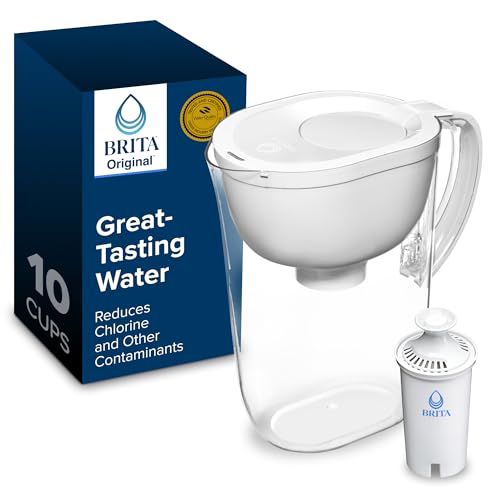
This is the classic Brita pitcher that has been a staple in millions of kitchens. The 10-cup capacity fits easily on refrigerator shelves — the dimensions are 10.7″ by 5.4″ — and it’s enough to fill three 24-ounce reusable bottles in one go. It comes with one standard filter included, so you’re ready to start filtering immediately. The easy-fill locking lid prevents splashes during refills, and the ergonomic handle makes pouring simple even when full.
The pitcher is BPA-free and compatible with both Brita Standard filters (40 gallons) and Longlast filters (120 gallons). Depending on which filter you use, you can space replacements from every two months to every six months. It reduces chlorine taste and odor, mercury, copper, zinc, and cadmium, all verified by NSF testing. The slim footprint means it won’t dominate your fridge shelf, though the 10-cup total capacity may require mid-day refills for households drinking more than eight glasses per person daily.
For a straightforward, no-fuss entry into filtered water, this pitcher delivers. It’s not the most advanced filter on this list, but it is the most turnkey — just fill, refrigerate, and pour. The cost per filter cycle is low, and replacement filters are widely available at most grocery stores and online. If you want a single solution for one or two people, this is the benchmark.
Why it’s great
- Compact fridge-friendly design that fits on standard shelves.
- Compatible with both Standard (40 gal) and Longlast (120 gal) filters.
- BPA-Free and NSF certified to reduce chlorine, mercury, copper, zinc, and cadmium.
Good to know
- Includes only one standard filter, not a multi-pack.
- 10-cup capacity requires frequent refills for larger families.
- Does not reduce fluoride or total dissolved solids.
4. PUR 30-Cup Countertop Water Filter Dispenser, DS1800Z

The PUR 30-Cup dispenser is built for volume. With a 7.09-liter capacity, it holds enough filtered water for a family of four to drink the recommended eight glasses per day without a single refill. The slim profile (5.3″ wide) helps it fit on crowded countertops, and the pull-down spout makes filling large pots or multiple bottles easier than tipping a pitcher. The included carrying handle simplifies transporting it to the sink for refills.
It ships with one genuine PUR filter that lasts 40 gallons or about two months. The 2-in-1 filtration media targets chlorine, mercury, copper, and zinc, and it’s NSF certified against those contaminants. Importantly, PUR filters are specifically designed and certified for use in PUR dispensers — using generic compatible filters may void the certification. The entire dispenser is dishwasher safe (top rack), so cleaning is straightforward.
If you entertain often or have a large household, this dispenser eliminates the constant fill-and-chill cycle of smaller pitchers. The countertop placement means it takes up fridge space but is always accessible. The replacement filter cost is comparable to other mid-range options, and the filter change reminder on the dispenser lid helps keep track of the 40-gallon cycle. It’s a practical, high-volume solution for busy kitchens.
Why it’s great
- 30-cup capacity serves large families without constant refilling.
- Dishwasher safe for easy cleaning and maintenance.
- NSF certified to reduce chlorine, mercury, copper, and zinc.
Good to know
- Only works with genuine PUR filters; third-party filters void certification.
- Countertop design requires dedicated surface space.
- Filter life is 40 gallons, not the extended 120-gallon standard.
5. Amazon Basics 10-Cup Pitcher with Filter

The Amazon Basics 10-Cup Pitcher is essentially a Brita-compatible system at a lower entry price. It holds 10 cups of water and is made in Europe, and the included filter is WQA and NSF certified for contaminant reduction. This means it undergoes independent testing similar to the big-name brands, despite the lower sticker price. The pitcher is designed to fit standard refrigerator shelves, much like the Brita large pitcher, and uses filters that are compatible with Brita systems.
Build quality is solid for the price point. The lid seals well to prevent debris from entering, and the spout pours cleanly without dribbling. Replacement filters are inexpensive and widely available. The BPA-free plastic body feels durable enough for daily use. One thing to note: the initial filter may have a short lifespan, so budget for replacements after the first two months.
If your main concern is baseline filtration for taste and odor at the lowest total cost, this is your entry point. It doesn’t offer the high-density media of the Brita Plus or the zero-TDS performance of Zerowater, but it removes enough chlorine and sediment to improve tap water significantly. For a solo drinker or a couple on a tight budget, this pitcher delivers certified performance at a bargain price.
Why it’s great
- WQA and NSF certified for independent quality assurance.
- Brita-compatible filters for easy and cheap replacements.
- Budget-friendly entry point into filtered water.
Good to know
- Standard carbon filtration; does not reduce TDS or heavy metals deeply.
- 10-cup capacity may be insufficient for larger households.
- Filter life is standard 40 gallons, not a long-life option.
FAQ
How often should I replace an inexpensive water filter?
Do cheap water filters remove lead and PFAS?
Can I use a generic filter in a Brita or PUR pitcher?
Final Thoughts: The Verdict
For most users, the inexpensive water filter winner is the Zerowater 5-Stage 2-Pack because it delivers the purest water by removing virtually all dissolved solids at a cost that rivals standard carbon filters. If you want the easiest upgrade for an existing Brita system, grab the Brita Plus 4-Pack. And for a large family needing high volume without counter clutter, nothing beats the PUR 30-Cup Dispenser.