A Japanese Santoku knife lives or dies by its edge geometry. The “three virtues” design — ideal for slicing, dicing, and mincing — demands a blade that glides through produce without wedging or tearing. Too many so-called Santoku knives on the market arrive dull or lose their bite after a week of prep.
I’m Mohammad Maruf — the founder and writer behind AirfryerBite. I’ve analyzed hundreds of blade steel compositions, edge retention tests, and handle ergonomics to separate true Japanese Santoku performance from stamped steel marketing.
Whether you’re breaking down a case of onions or prepping a quick weeknight stir-fry, the right blade transforms your workflow. This guide evaluates the best japanese santoku knife options by steel quality, balance, and real-world cutting feel.
How To Choose The Best Japanese Santoku Knife
A Santoku knife is a do-everything blade, but comfort and edge stability depend on steel composition, blade geometry, and handle fit. Focus on these three factors to avoid a purchase you’ll regret after a month of daily use.
Steel Core and Hardness (HRC)
The core steel determines how long the edge lasts and how easily it sharpens. VG10 holds a fine edge at HRC 60-61 and resists corrosion well, while higher-carbon variants like VG-MAX or 10Cr15CoMoV can push hardness to HRC 62-64 for superior edge retention. A blade below HRC 58 will dull noticeably faster during heavy vegetable prep.
Blade Thickness and Grind
A true Santoku uses a thin blade — typically 1.5 mm to 2.5 mm at the spine — combined with a flat or slight convex grind. This geometry reduces wedging in dense vegetables like carrots or sweet potatoes. Granton edges (hollow indentations) aid food release but slightly reduce blade strength; a hammered or tsuchime finish achieves similar non-stick performance without removing steel from the cutting edge.
Handle Material and Balance
Western-style handles (Pakkawood, G10, or synthetic composites) offer a heavier, more balanced feel for cooks transitioning from European chef knives. Traditional Japanese wa-handles (octagonal or D-shaped magnolia wood) shift the balance forward for greater nimbleness. For wet or slippery hands, G10 and textured synthetic handles provide a more secure grip than smooth Pakkawood.
Quick Comparison
On smaller screens, swipe sideways to see the full table.
| Model | Category | Best For | Key Spec | Amazon |
|---|---|---|---|---|
| Shun Classic 7″ Hollow Ground | Forged Damascus | Premium edge retention & food release | VG-MAX core, HRC 61, 16° edge | Amazon |
| Yoshihiro VG10 Hammered Damascus | Handcrafted Japanese | Traditional craftsmanship & versatility | VG10 core, HRC 60, 16-layer Damascus | Amazon |
| Global 7″ Hollow Ground | Stamped Stainless | One-piece seamless build | CROMOVA 18 steel, ice-hardened | Amazon |
| KYOKU Shogun Series VG10 | Forged Damascus | VG10 performance with full warranty | HRC 58-60, G10 handle, 67-layer Damascus | Amazon |
| HOSHANHO Damascus 10Cr15CoMoV | Forged Damascus | High hardness at an approachable price | HRC 62-64, G10 handle, 67-layer clad | Amazon |
| Mercer Culinary Renaissance Forged | Forged German Steel | Ergonomic fit for long prep sessions | High-carbon German steel, forged riveted | Amazon |
| Victorinox Fibrox 7″ Santoku | Stamped Stainless | Budget-friendly lightweight daily driver | Stainless steel, 6.7″ blade, granton edge | Amazon |
In‑Depth Reviews
1. Shun Classic 7″ Hollow Ground Santoku Knife
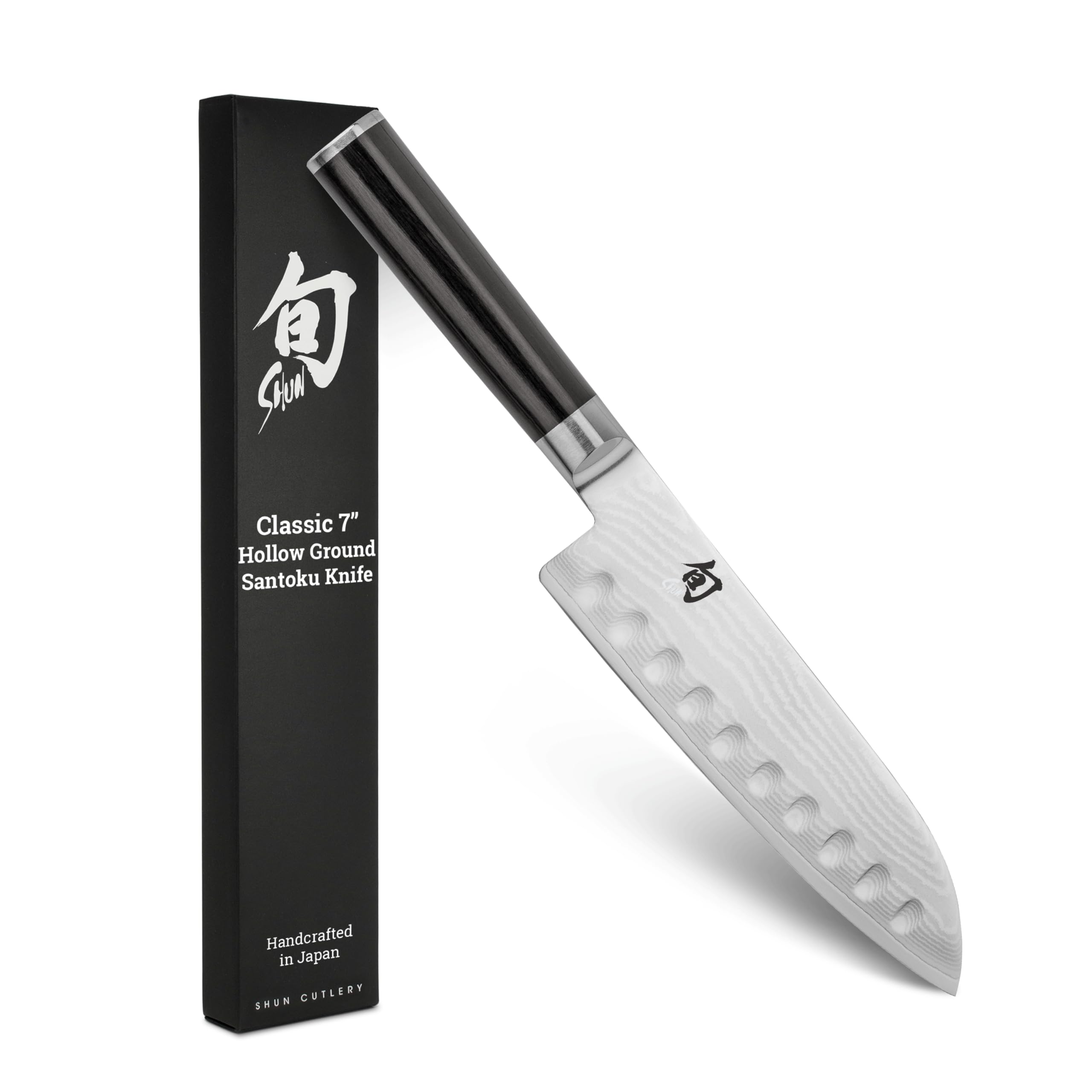
Shun’s Classic line set the standard for Japanese cutlery in the United States, and the 7-inch Hollow Ground Santoku remains the flagship. The VG-MAX core — a proprietary alloy with higher carbon and vanadium than standard VG10 — reaches HRC 61 and holds a 16-degree edge through heavy prep without micro-chipping. The 68-layer Damascus cladding not only creates the signature ripple pattern but also protects the core from corrosion while reducing sticking during slice cuts.
The D-shaped Pakkawood handle fills the palm evenly, providing a neutral balance point that suits both rock-chopping and push-cutting styles. Hollow-ground Granton indentations along the blade face actively release food, so sliced mushrooms or cucumber rounds don’t accumulate on the steel. Every Shun ships with a free sharpening service certificate, which offsets the long-term maintenance cost for cooks who lack waterstone experience.
At 0.6 pounds, the knife feels substantial but not heavy, and the full-tang construction eliminates flex during hard squash cuts. Hand-wash only — the Pakkawood handle will crack in a dishwasher. For cooks who want a single Santoku that performs from day one and stays sharp for years, this is the benchmark.
Why it’s great
- VG-MAX steel offers noticeably longer edge retention than standard VG10
- 68-layer Damascus cladding reduces food stick
- Free sharpening service included with purchase
Good to know
- Not dishwasher safe — Pakkawood handle requires hand drying
- Edge is brittle if used on bones or frozen foods
2. Yoshihiro VG10 16 Layer Hammered Damascus Santoku (7″)

Yoshihiro’s hammered Damascus Santoku is forged in Japan with a VG10 core clad in 16 layers of stainless steel. The HRC 60 rating delivers a keen edge that sharpens easily on water stones, a hallmark of traditional Japanese knife maintenance. The tsuchime (hammered) texture serves a functional purpose: it creates micro-air pockets between the blade and food, significantly reducing sticking during vegetable prep.
The western-style mahogany handle extends to a full tang, giving the knife a balanced forward-leaning weight that suits pinch-grip users. At 0.39 pounds, it’s one of the lighter forged Santoku options, reducing wrist fatigue during extended chopping sessions. The double-edged blade (sharpened symmetrically on both sides) makes it accessible to right- and left-handed cooks alike.
Yoshihiro recommends sharpening exclusively with water whetstones and immediate hand-washing after acidic ingredients like tomatoes or citrus. The hammered finish can trap moisture if not dried thoroughly, so a quick towel wipe is essential. For purists who value handcrafted Japanese forging over mass-production, this knife delivers an authentic experience at a mid-premium price point.
Why it’s great
- Hammered tsuchime finish actively prevents food sticking
- Lightweight forged construction (0.39 lb) reduces hand fatigue
- Genuine Japanese VG10 core sharpens predictably on water stones
Good to know
- Not dishwasher safe — mahogany handle is sensitive to prolonged moisture
- Requires water stone maintenance; pull-through sharpeners can damage edge
3. Global 7″ Hollow Ground Santoku Knife (G-80)

Global’s G-80 is constructed from a single piece of CROMOVA 18 stainless steel — the handle, bolster, and blade are one continuous element with no seams or rivets. This eliminates any crevices where food debris or bacteria could accumulate, making it one of the most hygienic Santoku designs on the market. The ice-hardening process brings the steel to HRC 58-59, prioritizing flexibility over extreme hardness, which reduces the risk of chipping.
The hollow ground edge creates a concave bevel that thins the blade behind the cutting edge, allowing it to pass through dense ingredients with less resistance. The dimpled stainless handle feels cool and smooth, though cooks with wet or oily hands may find it slippery compared to textured synthetics. At 6 ounces, the knife has a balanced, neutral feel that works well for both fine slicing and general chopping.
Global’s edge geometry responds well to the company’s proprietary sharpening system, but standard pull-through sharpeners may not align with the hollow grind. Hand-washing is mandatory — the seamless handle can trap water if submerged. For home cooks who prioritize easy cleaning and a modern aesthetic, the G-80 is a reliable, low-maintenance choice.
Why it’s great
- One-piece stainless construction has zero crevices for bacteria
- Ice-hardened CROMOVA 18 steel resists chipping
- Hollow ground edge slices through dense vegetables with low friction
Good to know
- Smooth handle can be slippery when hands are wet or greasy
- Not dishwasher safe and requires specific sharpening alignment
4. KYOKU Santoku Knife 7″ Shogun Series
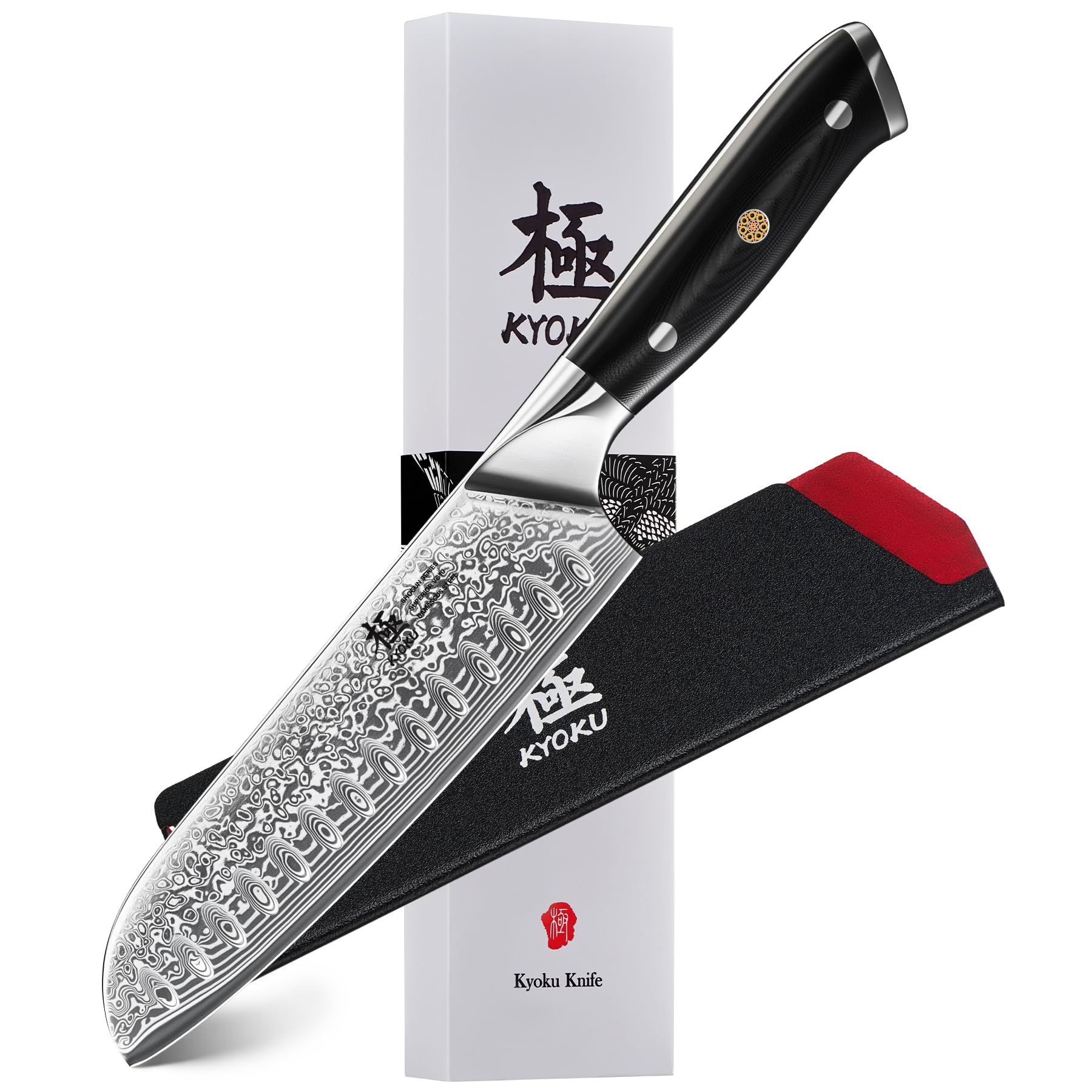
KYOKU’s Shogun Series delivers a 67-layer Damascus blade with a VG10 Japanese steel core at a mid-range price that undercuts many competitors. The HRC 58-60 range gives a balance of sharpness and toughness that handles everyday vegetable prep without the brittleness of higher-hardness blades. The extra-wide blade geometry — slightly wider than standard Santoku profiles — provides more knuckle clearance for cooks with larger hands.
The G10 handle is a fiberglass-based composite that resists heat, moisture, and impact better than wood or standard Pakkawood. It’s textured enough to maintain grip during fast chopping, and the full-tang construction keeps the knife balanced at the bolster. The included sheath and fitted case add protection for storage or transport, which is rare at this price tier.
KYOKU backs the knife with a lifetime warranty against defects, reflecting confidence in the forged construction. The double-sided edge is sharpened to 8-12 degrees per side using the Honbazuke method, producing a razor finish out of the box. Hand-wash only — the G10 handle is durable, but the Damascus cladding can develop patina if left wet.
Why it’s great
- Lifetime warranty covers defects and manufacturing issues
- G10 handle is highly resistant to heat, moisture, and impact
- Extra-wide blade provides better knuckle clearance
Good to know
- Requires hand-washing and immediate drying to prevent patina
- HRC 58-60 may need more frequent honing than harder blades
5. HOSHANHO Damascus Santoku Knife 7 Inch
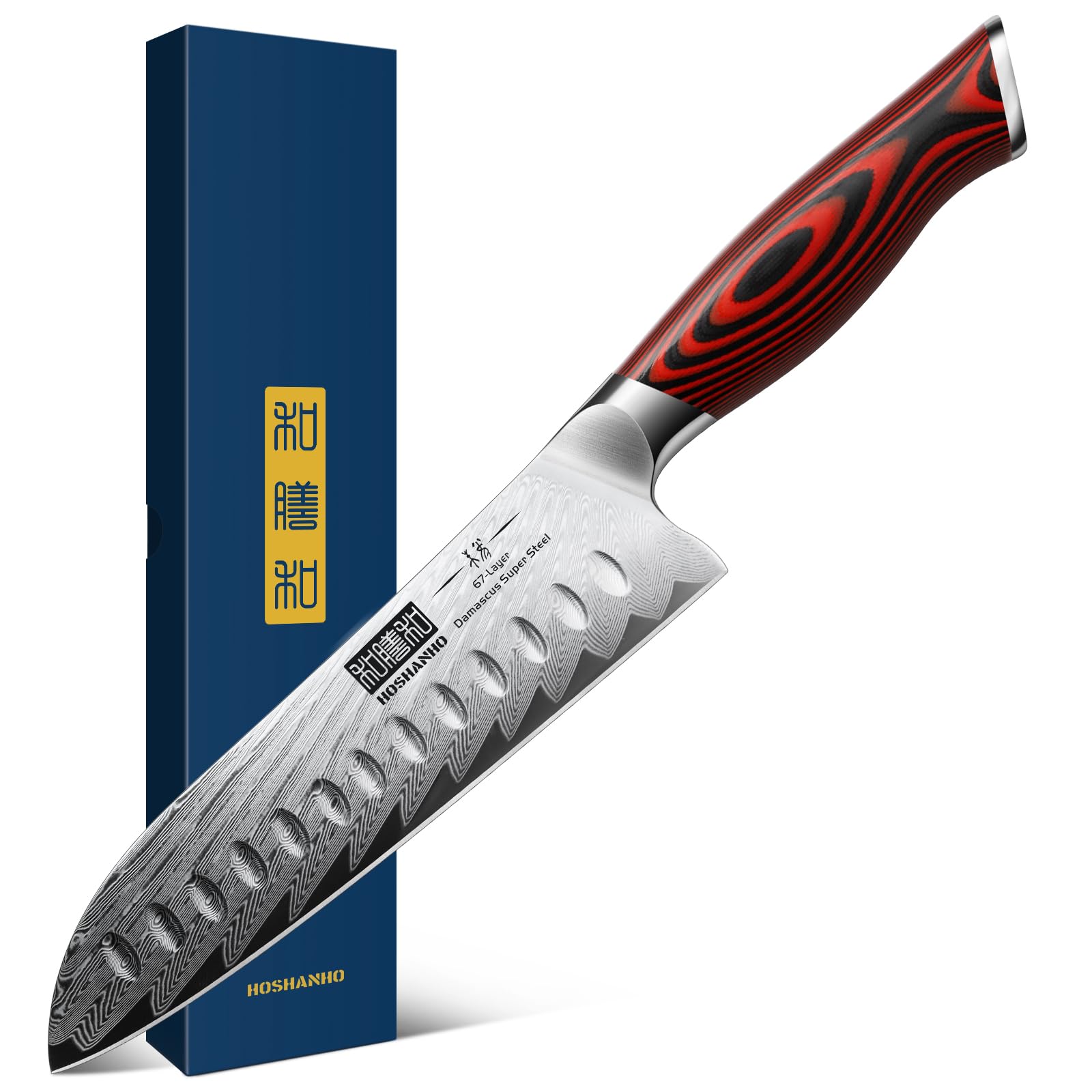
HOSHANHO uses 67 layers of Damascus steel cladding over a Japanese 10Cr15CoMoV core — a high-carbon alloy that includes cobalt and molybdenum for enhanced hardness. The blade reaches HRC 62-64, placing it among the hardest Santoku options available without jumping to premium boutique pricing. The vacuum heat treatment and liquid nitrogen cryogenic process stabilize the steel, reducing internal stress that can cause warping over time.
The G10 handle is glass-fiber-reinforced, offering better insulation and durability than wood handles at a similar weight. At 0.52 pounds with a blade thickness of only 0.08 inches, the knife feels nimble but not flimsy. The 12-15 degree double-sided bevel produces immediate slicing performance on tomatoes, bell peppers, and boneless proteins right out of the box.
The tsuchime-like Damascus pattern is sandblasted for improved corrosion resistance, though the high-carbon core still demands immediate drying after contact with acidic foods. Several early users report the edge holds noticeably longer than their previous VG10 knives, though the higher hardness means the blade is more prone to chipping if twisted against hard ingredients like bones or nuts.
Why it’s great
- HRC 62-64 provides exceptional edge retention between sharpenings
- G10 handle resists moisture and provides a secure grip
- Cryogenic treatment stabilizes steel for long-term durability
Good to know
- Harder edge is more brittle — avoid bone, nuts, and lateral twisting
- Not dishwasher safe; high-carbon core can discolor if left wet
6. Mercer Culinary Renaissance 7-Inch Santoku Knife

Mercer’s Renaissance series brings precision-forged high-carbon German steel to the Santoku shape, offering a Westernized take on the Japanese classic. The blade is fully forged — not stamped — which creates a denser grain structure that resists dulling through heavy use. The triple-riveted handle combines Delrin and Santoprene for a non-slip grip that remains comfortable even when hands are wet or greasy.
The Granton edge features shallow hollows along the blade face that reduce drag during slicing. At 6.4 ounces, the knife has a heftier feel than many Japanese Santoku options, which some cooks prefer for tasks that require a bit of weight behind the cut, like splitting small squash or dense cabbage. The rounded spine eliminates pressure points during extended pinch-grip sessions.
Mercer explicitly advises against dishwasher use — the high-carbon steel can discolor, and the handle materials may degrade over time. The knife is compatible with standard honing rods and pull-through sharpeners, making maintenance simpler than high-hardness Japanese steels. For cooks who want a forged blade with European durability and a familiar handle feel, the Renaissance delivers reliable performance.
Why it’s great
- Forged high-carbon German steel offers excellent edge stability
- Santoprene/Delrin handle provides slip-resistant grip when wet
- Rounded spine prevents hot spots during extended use
Good to know
- Heavier than traditional Japanese Santoku knives (6.4 oz)
- Not dishwasher safe — hand-wash and dry immediately
7. Victorinox Fibrox 7 In. Santoku Knife

The Victorinox Fibrox Santoku is the most budget-friendly entry in this guide, but calling it a compromise undersells its performance. The stamped stainless steel blade is laser-cut and precision-honed to a sharp factory edge that requires only occasional touch-ups on a honing steel. At 4.16 ounces, it’s the lightest knife here, making it ideal for cooks with smaller hands or those who prefer minimal fatigue during long prep sessions.
The Fibrox handle is a textured synthetic that provides positive grip even with oily or wet hands, and the blade features a Granton edge to reduce sticking. Unlike nearly every other knife in this guide, the Fibrox is explicitly dishwasher safe, which simplifies cleanup for cooks who prioritize convenience over edge longevity. The edge will degrade faster if run through a dishwasher regularly, but the low replacement cost mitigates that concern.
Multiple professional culinary schools issue Victorinox Fibrox knives to students because of the consistent quality and forgiving edge geometry. The blade won’t hold an edge as long as a VG10 or VG-MAX knife, but it sharpens quickly on any standard tool. For a first Japanese-style Santoku or a beater knife for rough tasks, the Fibrox offers genuine value without deceptive marketing.
Why it’s great
- Extremely lightweight (4.16 oz) reduces hand fatigue
- Dishwasher safe — unique among Santoku recommendations
- Textured synthetic handle maintains grip when wet or oily
Good to know
- Stamped blade loses edge faster than forged alternatives
- Not aesthetically distinctive — purely functional design
FAQ
Is a higher HRC always better for a Japanese Santoku knife?
Can I sharpen a Japanese Santoku knife with a pull-through sharpener?
What does the Granton edge on a Santoku knife actually do?
Why are most Japanese Santoku knives not dishwasher safe?
Final Thoughts: The Verdict
For most users, the best japanese santoku knife winner is the Shun Classic 7″ Hollow Ground because it combines a premium VG-MAX core with reliable Damascus cladding and a comfortable Pakkawood handle at a price that justifies the investment. If you want the traditional handcrafted feel of genuine Japanese forging with a hammered finish, grab the Yoshihiro VG10 Hammered Damascus. And for an affordable, lightweight entry point that still cuts well, nothing beats the Victorinox Fibrox 7″ Santoku.