Getting consistently ground coffee beans without spending a fortune is the single biggest hurdle for anyone moving past pre-ground bags. A grinder that produces uneven particle sizes or overheats the beans can sabotage the flavor of even the best single-origin roast, making your morning brew taste flat or bitter.
I’m Mohammad Maruf — the founder and writer behind AirfryerBite. My research focuses on the hardware that defines kitchen precision, from burr geometry and motor wattage to the number of grind settings that actually produce a usable particle distribution for different brew methods.
This guide walks through seven top options that balance real grinding performance with approachable pricing, so you can confidently choose the entry level coffee grinder that fits your brewing style and counter space.
How To Choose The Best Entry Level Coffee Grinder
Selecting your first dedicated coffee grinder comes down to three critical factors that directly affect grind quality, versatility, and ease of daily use. Ignore marketing fluff and focus on the burr type, the range of grind settings, and the build materials.
Burr Type: Conical vs. Flat vs. Blade
The burr mechanism determines particle uniformity more than any other single component. Conical burr grinders, like those in the TIMEMORE and OXO units, crush beans between a moving inner cone and a stationary outer ring, producing consistent flakes that extract evenly. Flat burrs, found on the Cuisinart model, grind between two parallel rings and can produce slightly more fines at the cost of a more compact footprint. Blade grinders chop beans randomly and create a chaotic mix of dust and chunks — avoid them entirely for serious brewing.
Grind Settings and Adjustment Range
The number of distinct grind positions dictates how precisely you can match particle size to your brew method. A grinder with 15 to 18 settings, like the OXO Brew, covers the essentials from fine espresso to coarse French press. Units with 48 or 51 settings, such as the SHARDOR and Aromaster, allow micro-adjustments that matter when dialing in pour-over or a specific espresso shot. Manual grinders often use a stepless adjustment dial, which offers infinite variability but requires a steady hand to maintain repeatability.
Build Materials and Cleaning Accessibility
Entry-level electric grinders often use plastic housings and hoppers, which keep weight and cost low. The OXO uses Tritan renew for its container, while the SHARDOR builds the body from stainless steel for added rigidity. Manual grinders like the VSSL and Alpaca Ventures use aluminum and stainless steel to resist rust and survive travel. Removable burrs and a supplied cleaning brush, as seen on the TIMEMORE and Aromaster, make maintenance straightforward — critical because stale coffee oils trapped in the burrs will taint subsequent batches.
Quick Comparison
On smaller screens, swipe sideways to see the full table.
| Model | Category | Best For | Key Spec | Amazon |
|---|---|---|---|---|
| OXO Brew Compact | Electric | Pour-over & drip | 15 settings + 29 micro-adjustments | Amazon |
| Cuisinart DBM-8P1 | Electric | Family brewing | 18 grind settings | Amazon |
| SHARDOR CG018 | Electric | Espresso dial-in | 51 grind settings | Amazon |
| TIMEMORE C3S | Manual | Precision pour-over | Stepless adjustment | Amazon |
| Aromaster 204 | Electric | High-volume grinding | 48 grind settings | Amazon |
| Alpaca Ventures AV 1 | Manual | Travel & camping | Dual-bearing design | Amazon |
| VSSL Java G25 | Manual | Adventure & durability | 50 grind settings | Amazon |
In‑Depth Reviews
1. OXO Brew Compact Conical Burr Coffee Grinder

The OXO Compact packs a surprising amount of grinding precision into a slender 4-inch-wide footprint. Its stainless steel conical burrs produce consistently sized particles, and the 15 main settings each have 29 micro-adjustments beneath them — effectively giving you hundreds of usable positions without overwhelming a new user. The 50-gram bean hopper holds enough for roughly six cups, making it a strong fit for daily drip or pour-over routines.
Both the upper and lower burrs are fully removable for cleaning, a feature that some mid-range grinders omit. The housing and containers are made from Tritan renew, a recycled-content plastic that feels sturdy and is food-safe. At just over 10 inches tall, it slides under most upper cabinets without being a permanent countertop anchor.
The plastic construction keeps weight down but means the grinder can shift slightly during operation if you press the lid too hard. For the combination of grind consistency, compact size, and removable burrs, this is the most balanced entry point for someone who wants electric convenience without stepping into premium pricing territory.
Why it’s great
- Removable stainless steel burrs for easy cleaning
- Narrow footprint saves counter space
- Micro-adjustment system allows fine-tuning
Good to know
- Plastic body feels lighter than all-metal alternatives
- Capacity limited to about six cups per load
2. Cuisinart DBM-8P1 Electric Burr Coffee Grinder
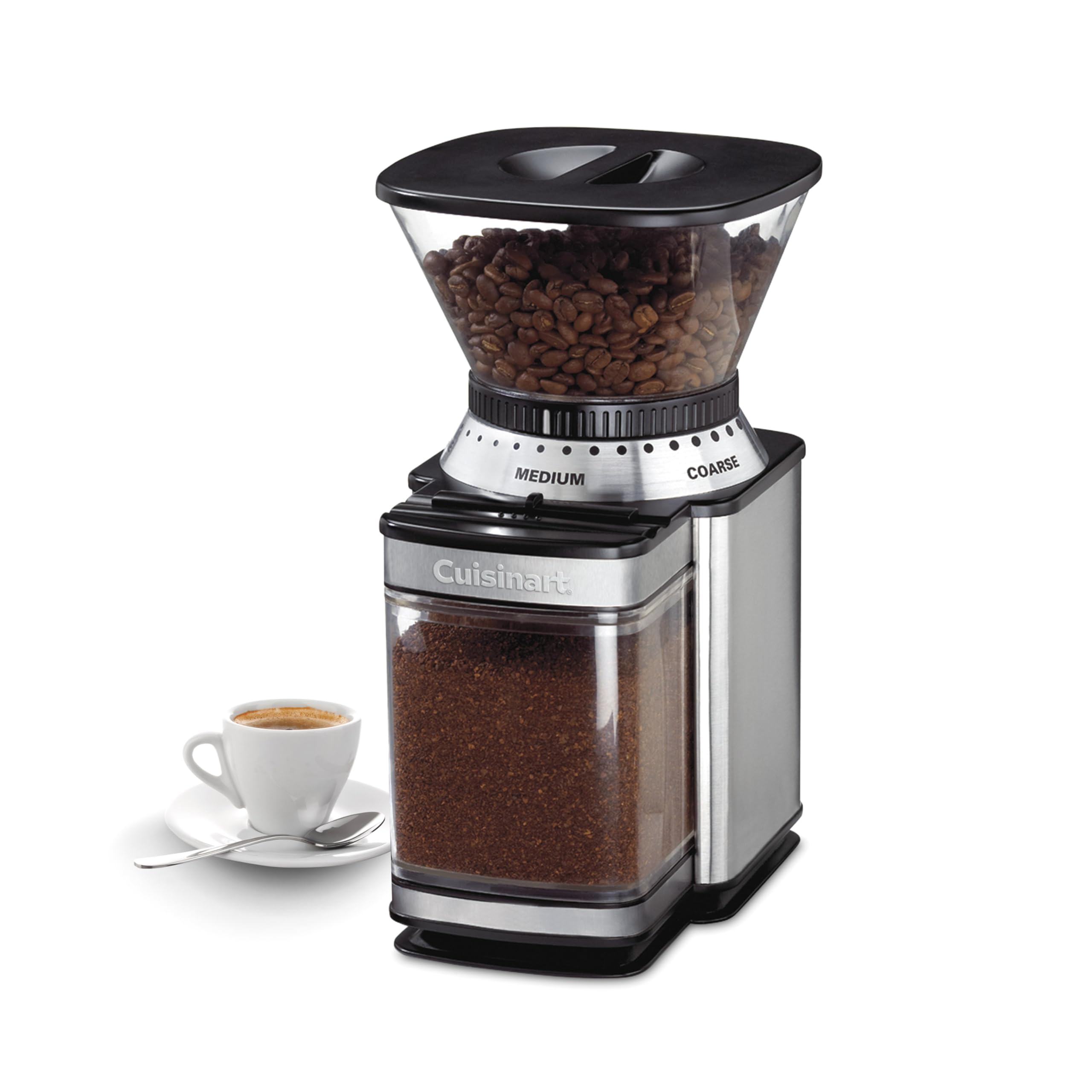
Cuisinart’s DBM-8P1 is one of the most recognized flat burr grinders in the entry-level electric segment, and for good reason. The 18-position slide dial gives you a clear grind range from ultra-fine to extra-coarse, and the one-touch power bar with an internal timer shuts off automatically at the end of the cycle. The 8-ounce bean hopper and removable grind chamber accommodate 4 to 18 cups, so it naturally suits larger households.
The flat burr design is compact and predictable, but it does generate more heat retention than a conical burr, which can have a minor impact on the lighter floral notes of delicate single-origin beans. The grind chamber is removable for emptying, but the burrs themselves require a bit more effort to access for a deep clean compared to the OXO’s fully detachable system.
Cord storage underneath and the included scoop and cleaning brush keep the counter tidy. The heavy-duty motor runs reliably, and the stainless steel finish looks clean on most kitchen counters. For anyone brewing multiple pots a day, the Cuisinart delivers consistent throughput without breaking the bank.
Why it’s great
- Generous 8-ounce hopper for larger batches
- 18 settings cover espresso through French press
- Automatic shutoff timer adds convenience
Good to know
- Flat burrs retain slightly more heat than conical
- Burrs are not as easy to remove for thorough cleaning
3. SHARDOR CG018 Conical Burr Espresso Coffee Grinder

The SHARDOR CG018 brings a feature set usually reserved for grinders costing twice its price. The 40-millimeter stainless steel conical burrs operate at lower RPM to minimize heat transfer, preserving the volatile oils responsible for aroma and flavor. The 51 precise grind settings span the full brewing spectrum, and the digital touchscreen allows you to select grind time in 0.1-second increments for repeatable dosing.
A dedicated portafilter cradle lets you grind directly into your espresso basket, which streamlines the workflow significantly for espresso drinkers. The anti-static technology in the grounds chamber reduces the mess of flying fines, and the included residual cleaner helps keep the burr chamber free of stale coffee dust. The all-metal housing adds noticeable heft at over 6 pounds, which keeps the grinder stable during operation.
The touchscreen interface, while responsive, adds an electronic component that could be a failure point over the long term. For dialing in espresso shots with precision, the SHARDOR outperforms most grinders at this level.
Why it’s great
- 51 settings allow micro-adjustments for espresso
- Portafilter cradle speeds up workflow
- Anti-static technology reduces mess
Good to know
- Small capacity limits single-batch grinding
- Touchscreen electronics may be less durable than mechanical controls
4. TIMEMORE Chestnut C3S Manual Coffee Grinder

The TIMEMORE C3S is a manual grinder built around the company’s patented S2C steel conical burr, which produces an exceptionally uniform particle distribution for its class. The stepless grind adjustment allows infinite variability between espresso-fine and French-press-coarse, giving you the control to match any brew method precisely. The all-metal aluminum body feels substantial in the hand and eliminates the plastic components that can wear or crack over time.
At just 530 grams (about 1.2 pounds) and a 52mm diameter, the C3S is easy to grip and rotate during a grinding session. The 25-gram capacity covers a single dose or a generous mug, and the dual-bearing design keeps the shaft stable as you crank. Cleaning is a dry-brush affair — water will damage the burr set — and the included brush reaches into the burr teeth effectively.
Manual grinding takes about 30 to 45 seconds for a typical pour-over dose, which is faster than many budget hand grinders thanks to the efficient burr geometry. The absence of plastic parts means there is no risk of static cling flinging grounds everywhere. For the pour-over enthusiast who values grind quality over speed, the TIMEMORE C3S is a serious upgrade from the plastic-bodied hand grinders.
Why it’s great
- Patented S2C burr delivers outstanding particle uniformity
- All-aluminum build with no internal plastic
- Stepless adjustment lets you dial in any brew method
Good to know
- Manual operation requires arm effort each session
- Cleaning must be done with a brush only — no water
5. Aromaster 204 Conical Burr Coffee Grinder
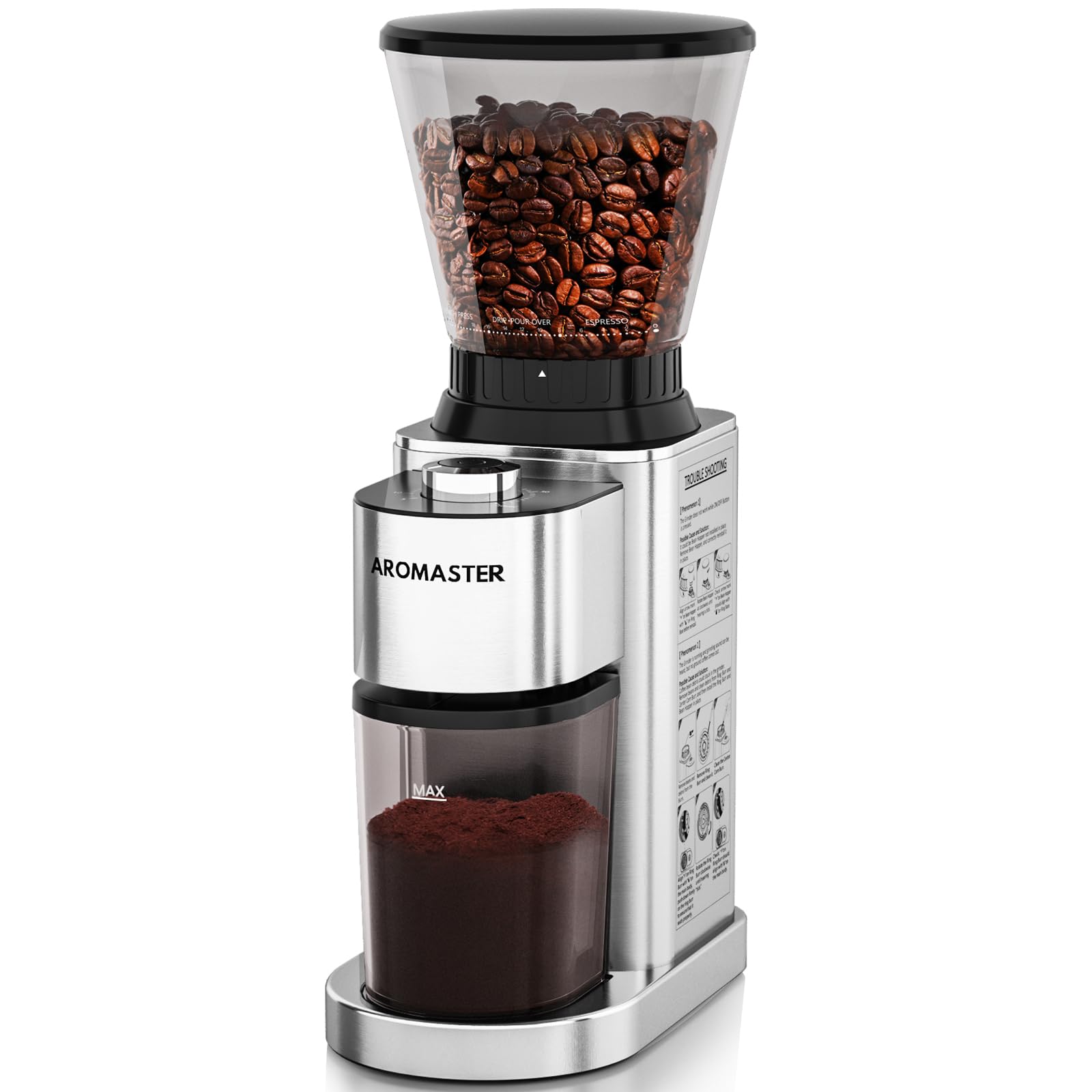
The Aromaster 204 offers one of the largest capacities in the entry-level electric category with a 3.9-ounce grounds chamber, enough for a full morning pot or multiple servings. The 48 grind settings provide fine-grained control from espresso powder to coarse French press particles, and the adjustable timer lets you program the grind duration up to 40 seconds for consistent batch sizes. The stainless steel conical burrs run at a slower speed to reduce heat buildup during longer grinding sessions.
Upgraded anti-static technology helps keep coffee dust from flying around the chamber and onto your countertop, and the tawny-colored bin design reduces UV exposure to the beans stored in the hopper. A built-in brush on the back of the bean hopper lid clears blockages without requiring extra tools. The removable ring burr makes deep cleaning straightforward when you need to switch coffee varieties.
The unit requires a 120V, 60Hz power supply, and the all-metal housing feels more robust than the plastic-heavy budget competitors. The 40-second timer means you may need two cycles for very large batches, but for most households the 3.9-ounce capacity is generous. For those who grind frequently and want a large catch bin, the Aromaster delivers strong volume without sacrificing grind quality.
Why it’s great
- Large 3.9-ounce grounds capacity for batch grinding
- 48 settings provide broad range for all brew methods
- Anti-static design reduces mess during use
Good to know
- Timer maxes out at 40 seconds per cycle
- Removable burr needs to be fully dry before reassembly
6. Alpaca Ventures AV 1 Manual Coffee Grinder

The Alpaca Ventures AV 1 is a compact manual grinder built around a 420-grade stainless steel conical burr and a dual-bearing crank mechanism that reduces the effort required to break through harder beans. The lengthened handle provides extra leverage, making the grinding motion smoother than many similarly priced hand grinders. The adjustment dial uses a click-style system for repeatable positioning across the espresso-to-French-press range.
Disassembly is tool-free — a simple twist separates the body, burr, and catch cup, making cleaning straightforward. The lightweight aluminum body weighs just one pound and measures only 6.3 inches tall, so it slips easily into a camping kit or a work bag. An included cleaning brush reaches into the burr teeth to remove trapped coffee particles.
The click-style adjustment dial may not offer the stepless precision of the TIMEMORE, but it provides enough repeatability for daily use across the most common brewing methods. The aluminum body, while light, is less impact-resistant than the fully machined VSSL unit. For anyone seeking a budget-friendly manual grinder that grinds with less effort than the cheapest alternatives, the Alpaca Ventures delivers reliable performance.
Why it’s great
- Dual bearings make cranking noticeably smoother
- Tool-free disassembly simplifies cleaning
- Compact and lightweight for travel
Good to know
- Click-style dial is less precise than stepless designs
- Aluminum body is light but not as rugged as steel alternatives
7. VSSL Java G25 Premium Manual Coffee Grinder
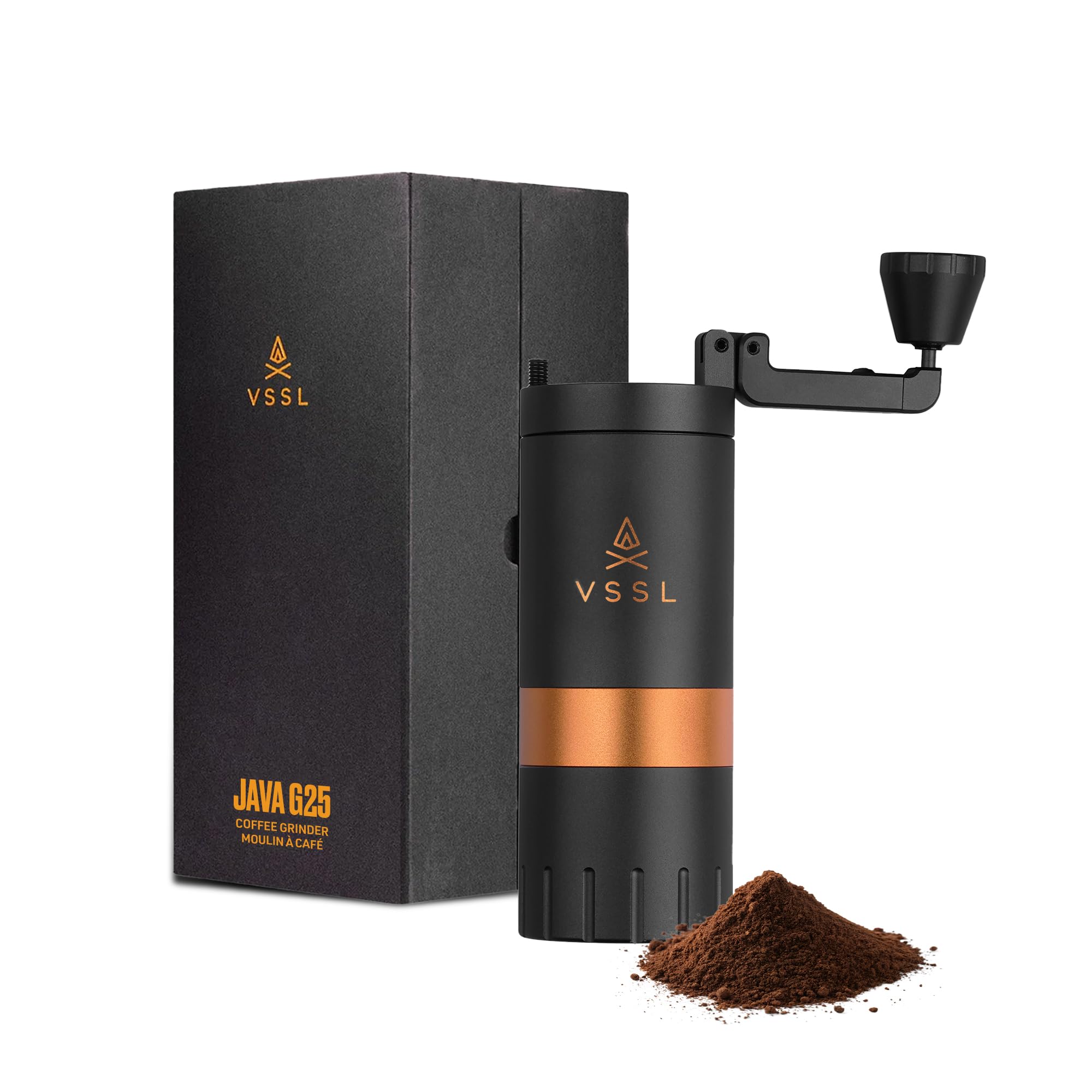
The VSSL Java G25 is built for the outdoors without compromising on grind quality. The high-carbon stainless steel conical burr, paired with 50 distinct grind settings, delivers the same particle consistency you would expect from a dedicated home grinder. The dual ball-bearing design eliminates burr wobble, and the push-button quick-release cap allows you to empty the grounds instantly without unscrewing multiple parts.
The body is machined from 6061 aircraft-grade aluminum, and the burr set is 304 food-grade stainless steel — VSSL claims the grinder survived being run over by a Jeep, and the construction feels that dense. The compact extendable handle locks into a carabiner-style loop for storage, making it easy to clip to a backpack. At 15.2 ounces and just over 6 inches tall, it is still light enough for backpacking but heavy enough to feel solid in the hand.
The 25-gram capacity is on par with other portable manual grinders, and the grinding speed is impressively fast — about a minute for a full load. The four-figure price tag positions it as a premium piece of gear rather than a casual entry-level purchase. For the adventurer who refuses to compromise on grind consistency, the VSSL Java G25 is the ultimate travel companion.
Why it’s great
- 50 settings provide cafe-level grind control
- Machined aluminum and stainless steel are virtually indestructible
- Folding handle with carabiner clip is ideal for travel
Good to know
- Premium price is significantly higher than other manual options
- 25-gram capacity limits single-serve use
FAQ
Should I choose a manual or electric entry-level coffee grinder?
How many grind settings do I need for pour-over and French press?
What is the difference between conical and flat burrs in an entry-level grinder?
How often should I clean my manual coffee grinder?
Can an entry-level grinder handle espresso consistently?
Final Thoughts: The Verdict
For most users, the entry level coffee grinder winner is the OXO Brew Compact Conical Burr Grinder because it combines electric convenience, fully removable burrs, and a micro-adjustment system that gives you real precision without a steep learning curve. If you want the grind-quality-to-dollar ratio of a manual grinder, grab the TIMEMORE Chestnut C3S. And for adventurers who need a rugged, packable grinder that delivers cafe-quality particles anywhere, nothing beats the VSSL Java G25.