Chasing a balanced espresso shot at home often ends in sour or over-extracted frustration. The difference between a muddy mess and a silky crema layer starts with particle uniformity — something only a dedicated grinder can deliver.
I’m Mohammad Maruf — the founder and writer behind AirfryerBite. My research focuses on home espresso workflows, burr geometry, and how grind consistency directly impacts extraction yield for non-commercial setups.
After analyzing nine grinders across manual, entry-level electric, and prosumer flat-burr categories, I mapped out which models actually hold setting stability and which introduce fines that choke your shot. This is the definitive research for anyone hunting a grinder for espresso at home.
How To Choose The Best Grinder For Espresso At Home
Espresso demands a grind that is both fine and narrow in particle distribution. A blade grinder produces shards and dust — unusable for pressure extraction. Every grinder on this list uses burrs, but the burr type, adjustment mechanism, and retention behavior define whether your shots repeat or drift.
Flat vs Conical Burrs
Flat burrs, particularly 64mm or larger, produce a more uniform particle size with a higher proportion of boulders and fewer fines. This translates to higher extraction yield and clearer flavor separation. Conical burrs (48mm to 55mm) generate more fines — which add body and texture but can choke finer grind settings. Choose flat burrs for clarity-oriented light roasts and conical burrs for traditional full-bodied medium-dark blends.
Stepless vs Stepped Adjustment
Stepped grinders lock into preset positions (usually 30 to 100 steps). A 30-step range is often insufficient for espresso because a single step can shift flow from 25 seconds to 15 seconds. Stepless adjustment — a rotating collar or knob with no detents — allows infinite micro-adjustment. This is non-negotiable for dialing in a specific bean and roast level.
Retention and Static Control
Any grinder that retains more than 0.5g of grounds in the chute after a single dose will stale your next shot and throw off dose weight. Look for anti-static coatings, plasma generators, or bellows-style single-dose hoppers that purge retained particles. The ideal home espresso grinder releases 99% of what you put in.
Quick Comparison
On smaller screens, swipe sideways to see the full table.
| Model | Category | Best For | Key Spec | Amazon |
|---|---|---|---|---|
| Eureka Mignon Specialita | Prosumer | Silent precision at home | 55mm flat burrs / stepless | Amazon |
| MOKKOM Professional 64mm | Mid-Range | Flat burr upgrade on a budget | 64mm stainless steel flat burrs | Amazon |
| SHARDOR CG301 | Mid-Range | 100-step precision espresso | 64mm flat burr / 100 settings | Amazon |
| TIMEMORE Sculptor 064S | Premium | Prosumer clarity in compact chassis | 64mm flat burr / variable RPM | Amazon |
| Baratza Sette 30 | Entry-Level | Fast grinding with minimal retention | Conical burr / 30 grind settings | Amazon |
| Eureka Mignon Notte | Entry-Level | Durable espresso-only workhorse | 50mm flat burr / stepless | Amazon |
| Viesimple Gen 4 | Entry-Level | Quiet operation with anti-static | 48mm conical burr / 5-blade | Amazon |
| TIMEMORE Sculptor 078S | Premium | Maximum burr surface for light roasts | 78mm flat burr / 800-1400 RPM | Amazon |
| KINGrinder K6 | Manual | Travel-ready espresso grinding | Conical burr / 16 um per click | Amazon |
In‑Depth Reviews
1. Eureka Mignon Specialita
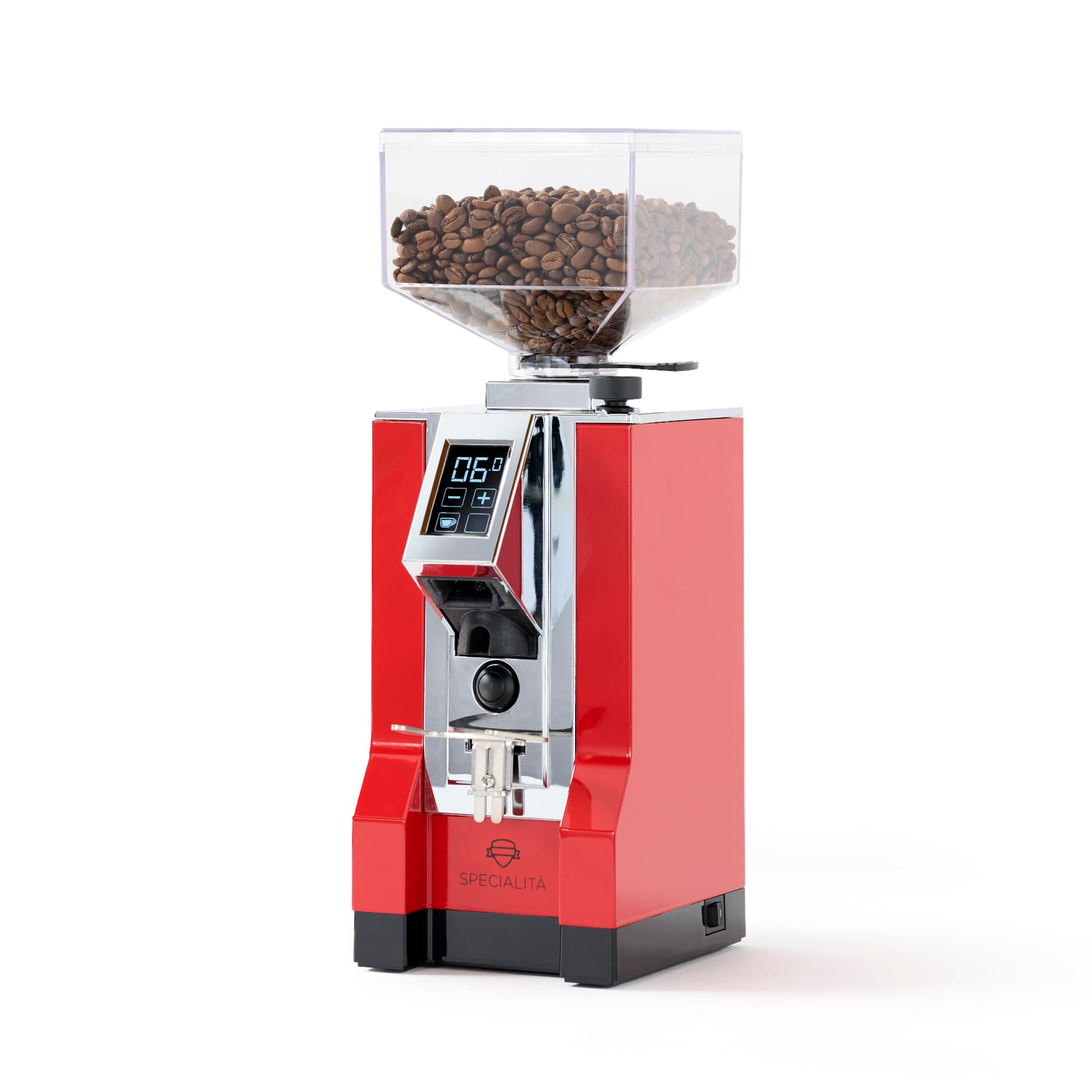
The Specialita carries the largest burrs in Eureka’s Mignon line — hardened steel 55mm flat burrs paired with a stepless adjustment knob mounted below the motor. This bottom-burr design preserves your dial-in setting when you disassemble for cleaning, a rare convenience in this price tier. The sound-insulated case drops decibel levels noticeably compared to the open-body Notte.
The backlit resistive touchscreen controls single, double, and continuous grind times with 0.1-second resolution. Retention is low — around 0.2g to 0.4g depending on static conditions — thanks to a wider chute and anti-clumping system that fluffs grounds before they exit. Handbuilt in Florence, the metal case and build tolerances feel substantially tighter than mass-produced alternatives.
At 550 watts and 55mm burrs, the Specialita chews through light-roast beans without stalling. The static-free fluffiness of the grounds reduces channeling in the portafilter. If your budget reaches this level, you get a grinder that holds setting across disassembly cycles and runs quieter than most espresso machines.
Why it’s great
- Sound-insulated case for early-morning grinding
- Bottom-burr adjustment preserves setting during cleaning
- Touchscreen timer with 0.1s precision
Good to know
- Single-dose hopper not included — add a bellows mod
- Burr alignment can drift with heavy use
2. MOKKOM Professional 64mm
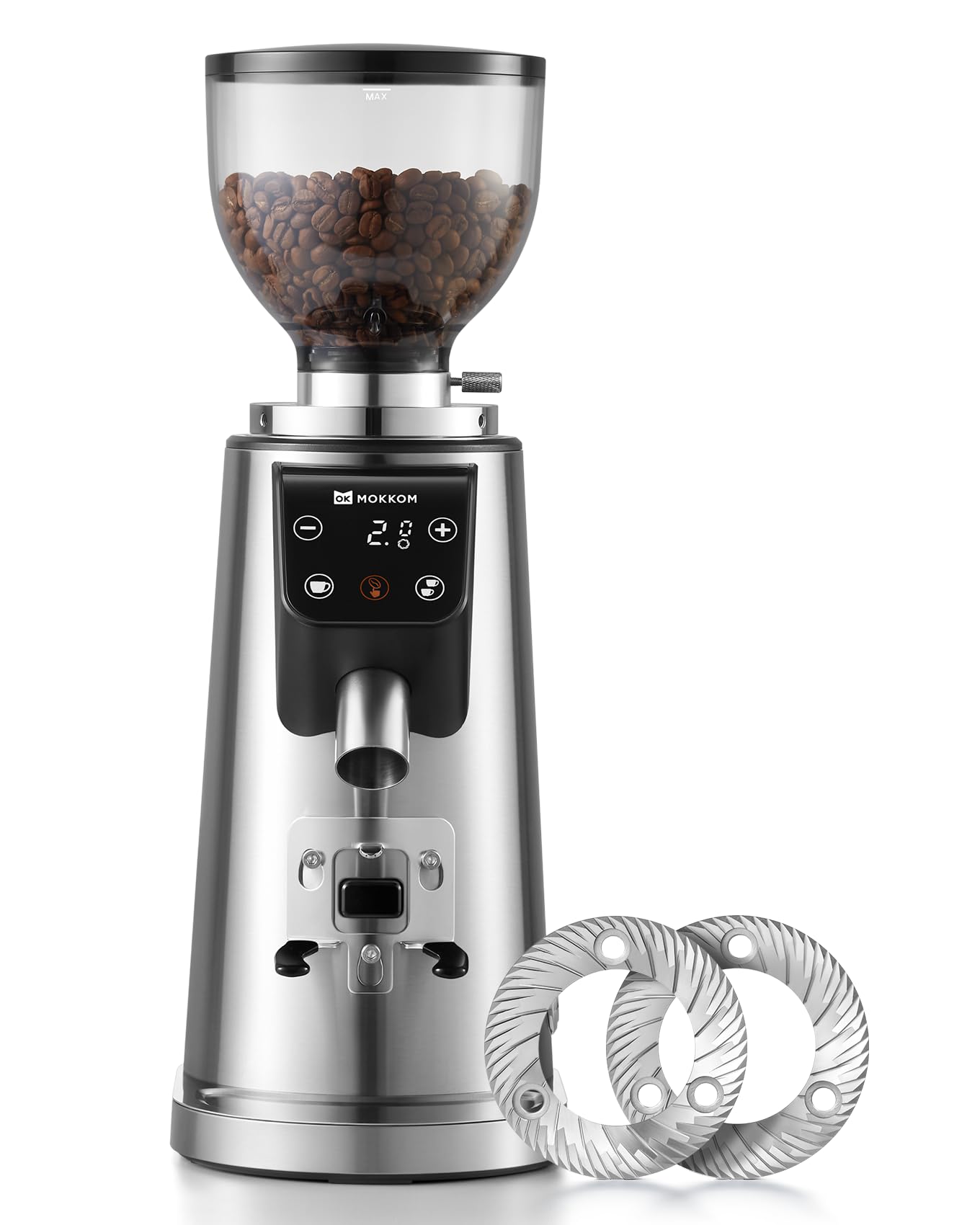
MOKKOM brings 64mm stainless steel flat burrs — a size typically found on grinders costing two to three times more — into a mid-range package. The burrs are driven by a 260W motor with a plasma generator inside the exit chute that neutralizes static cling. The full-metal stainless body and 7mm brass grind adjustment ring provide a heavy, stable platform that minimizes vibration during grinding.
The LED timer offers 0.1-second resolution across single, double, and continuous modes. Two bean hoppers are included: a 350g bulk hopper and a silicone bellows single-dose hopper that purges retention effectively. On light-roast Ethiopian beans, the 64mm flat burrs produced a noticeably cleaner bed in the portafilter compared to conical grinders at the same price.
With 100 grind settings and a stepless-style threaded adjustment, users can micro-adjust finer than most stepped machines. Customer reviews consistently mention that it outperforms grinders at two to three times the price on shot repeatability.
Why it’s great
- 64mm flat burrs at a mid-range price point
- Plasma generator keeps grounds from clumping
- Dual hopper system for bulk and single dosing
Good to know
- Brass ring needs occasional lubrication
- No RPM control for fine-tuning light roasts
3. SHARDOR CG301
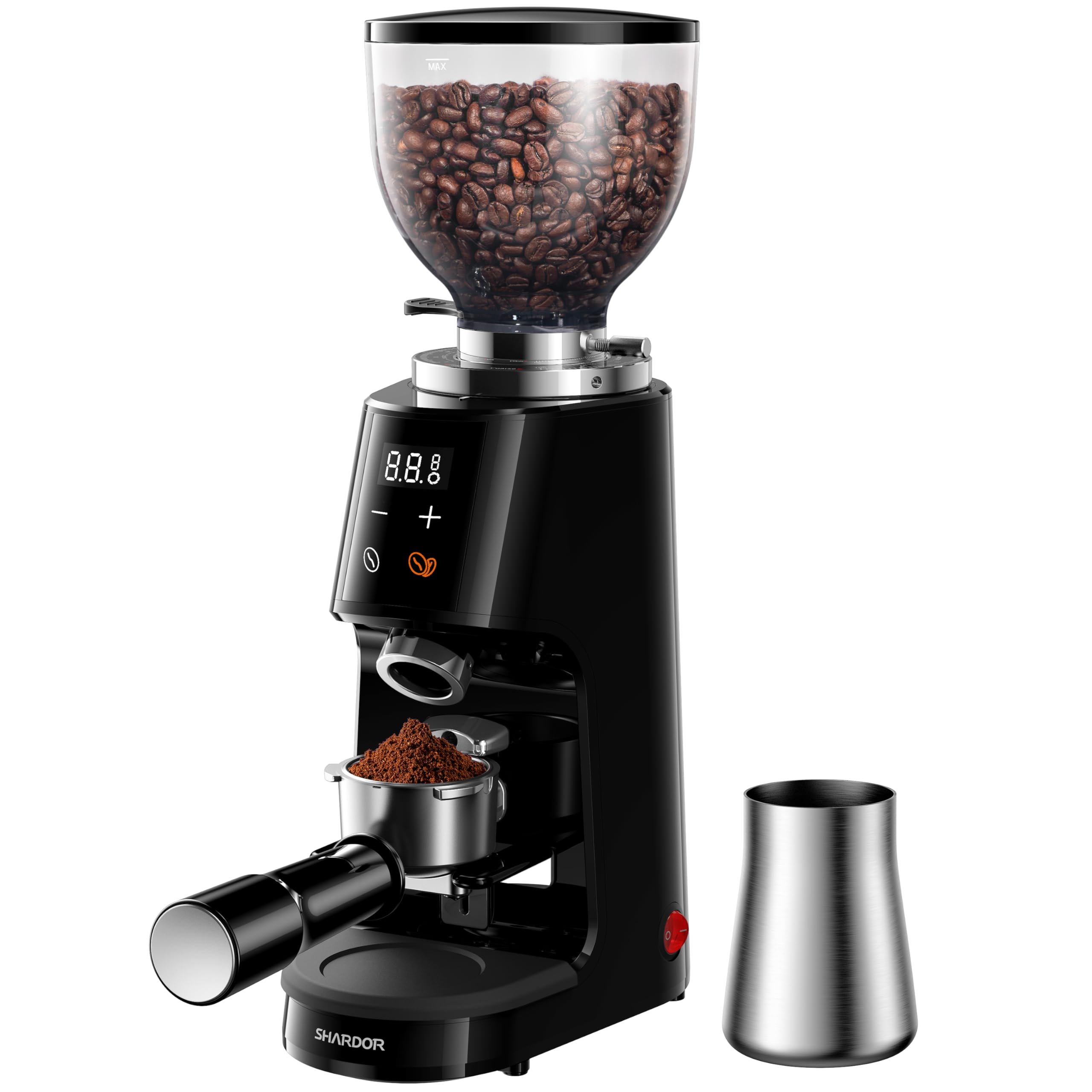
The SHARDOR CG301 uses the same 64mm flat burr format as the MOKKOM but focuses on an all-metal grinding chamber paired with a portafilter holder that allows hands-free grinding directly into the basket. The 100 grind settings span from Turkish-fine to cold-brew coarse, with the espresso range offering enough resolution for incremental dialing.
An anti-static system integrated into the stainless steel cup keeps the counter clean, though the real standout is the removable magnetic discharge pipe and upper burr carrier — disassembly takes seconds with no tools. The LED display allows 0.1-second timer increments, and the trap door design on the hopper lets you swap beans mid-dose without removing the entire lid.
Customer feedback highlights that the CG301’s grind quality rivals flat-burr machines at double the price, with consistent particle distribution that reduces channeling. The 120V-only restriction is a firm limitation for international buyers, but domestic users get a capable flat-burr entry point.
Why it’s great
- Portafilter holder for hands-free dosing
- Magnetic discharge pipe simplifies cleaning
- 100 grind settings with espresso range precision
Good to know
- 120V only — not compatible with 220V
- Single-dose hopper sold separately
4. TIMEMORE Sculptor 064S

TIMEMORE’s Sculptor 064S uses a patented flat burr geometry designed specifically for espresso clarity, paired with a sensorless brushless motor that runs zero-friction via PID control and Hall elements. This eliminates the vibration that brushed motors introduce, allowing the burrs to cut more precisely at every RPM setting. Adjustable speed ranges from 800 to 1200 RPM, giving you the ability to slow down for light roasts — reducing fines and increasing extraction yield.
The rotary knocker is a practical innovation: a quick turn after grinding frees most retained fines from the chute, dropping retention below 0.1g in practice. Magnetic alignment on both the bean container and the powder barrel ensures the grind path is always centered, and the magnetic lid seals the hopper with no thread wear over time.
At 150 watts, the motor is not the most powerful on the list, but the brushless torque curve maintains RPM under load better than a brushed equivalent. For home baristas who want prosumer grind quality without the footprint of a commercial 80mm burr grinder, the 064S delivers exceptional particle uniformity.
Why it’s great
- Variable RPM from 800 to 1200 for roast-specific tuning
- Rotary knocker minimizes retention
- Brushless motor with PID control
Good to know
- 150W motor can stall on very dense light roasts
- Single-dose only — no bulk hopper included
5. Baratza Sette 30

The Sette 30 was designed as an entry point to specialty espresso, featuring a 40mm conical burr set that grinds at up to 5g per second — among the fastest in its class. The straight-through path from burr to portafilter means retention typically stays around 0.1g to 0.2g, reducing stale grounds in subsequent shots. The digital timer resolves to 0.1 seconds, giving repeatable dose control by time rather than weight.
With only 30 grind settings, the step size between espresso adjustments is wider than ideal. A common workaround is to shim the burr carrier for finer resolution, but out of the box the Sette 30 can land between optimal extraction times on certain beans. The plastic housing feels lighter than competitors, though Baratza’s customer support and parts availability are industry benchmarks.
For someone moving from pre-ground to fresh grinding, the Sette 30’s speed and low retention make it forgiving. But the 30-step limitation means you may outgrow it once you need the micro-adjustment typical of darker roasts or humidity-sensitive beans.
Why it’s great
- 5g/second grind speed reduces wait time
- Very low retention for dose accuracy
- Baratza parts and support are easy to access
Good to know
- 30 steps are insufficient for precise espresso dialing
- Plastic build feels less durable than metal chassis
6. Eureka Mignon Notte

The Mignon Notte is Eureka’s most accessible espresso grinder, built around 50mm hardened steel flat burrs and a stepless adjustment knob that gives genuinely infinite granularity. The all-metal case and 15.2-pound weight signal a level of build quality that surpasses plastic-bodied competitors at similar price points. The manual dosing switch is activated by pressing the portafilter into a lever — simple, tactile, and predictable.
Stepless adjustment lets you dial in with precision that stepped grinders cannot match. The bottom-burr adjustment mechanism, unique to Eureka, means removing the upper burr for cleaning does not reset your grind setting. Retention sits around 0.3g to 0.5g, which is acceptable but not elite. The 150g bean hopper is small enough for single-dosing but lacks a bellows to purge retained grounds.
With a direct focus on espresso (no pour-over or French press pretensions), the Notte does one thing well. It lacks a timer, so you need a scale for consistent dosing, but the grind quality and repeatability justify the tradeoff.
Why it’s great
- Stepless adjustment for infinite grind control
- All-metal construction at a competitive price
- Bottom-burr design holds setting during cleaning
Good to know
- No grind timer — requires scale for dosing
- Minimal single-dose features out of the box
7. Viesimple Gen 4
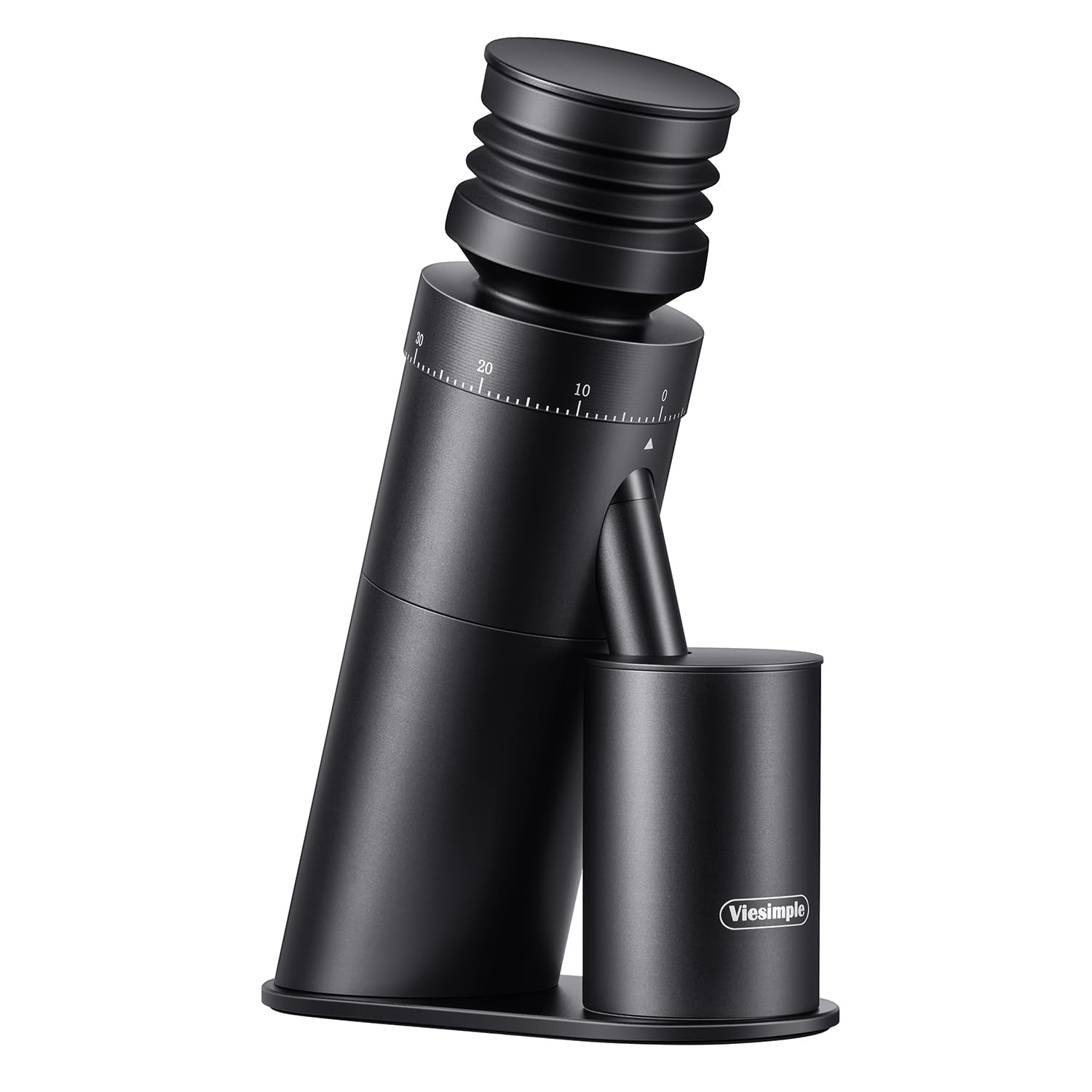
The Viesimple Gen 4 uses a 48mm conical burr set with a motor rated below 50 decibels — genuinely quiet enough to use without waking others. The aluminum body houses a patented anti-clogging powder channel that claims 100% discharge, with a food-grade anti-static coating holding debris residue below 0.2%. The magnetic dosing cup seals against flying grounds during transfer.
The included blow-out funnel is designed to purge the last grounds from the chute after grinding. For espresso, the conical burrs produce a higher proportion of fines, which can increase body but may worsen channeling in lighter roasts. The grind range covers espresso through French press, though the 48mm burrs mean slower throughput—around 1.5g to 2g per second at espresso settings.
The 2-year warranty and 100-240V compatibility make it a practical choice for international users or those who want a quiet, entry-level conical grinder. The motor’s 10-year lifespan claim is aggressive, but the build quality feels solid for the price tier.
Why it’s great
- Sub-50 dB noise level for silent morning use
- Anti-clogging channel and anti-static coating
- Worldwide voltage compatibility
Good to know
- 48mm conical burrs produce more fines
- Slower grind speed at fine settings
8. TIMEMORE Sculptor 078S
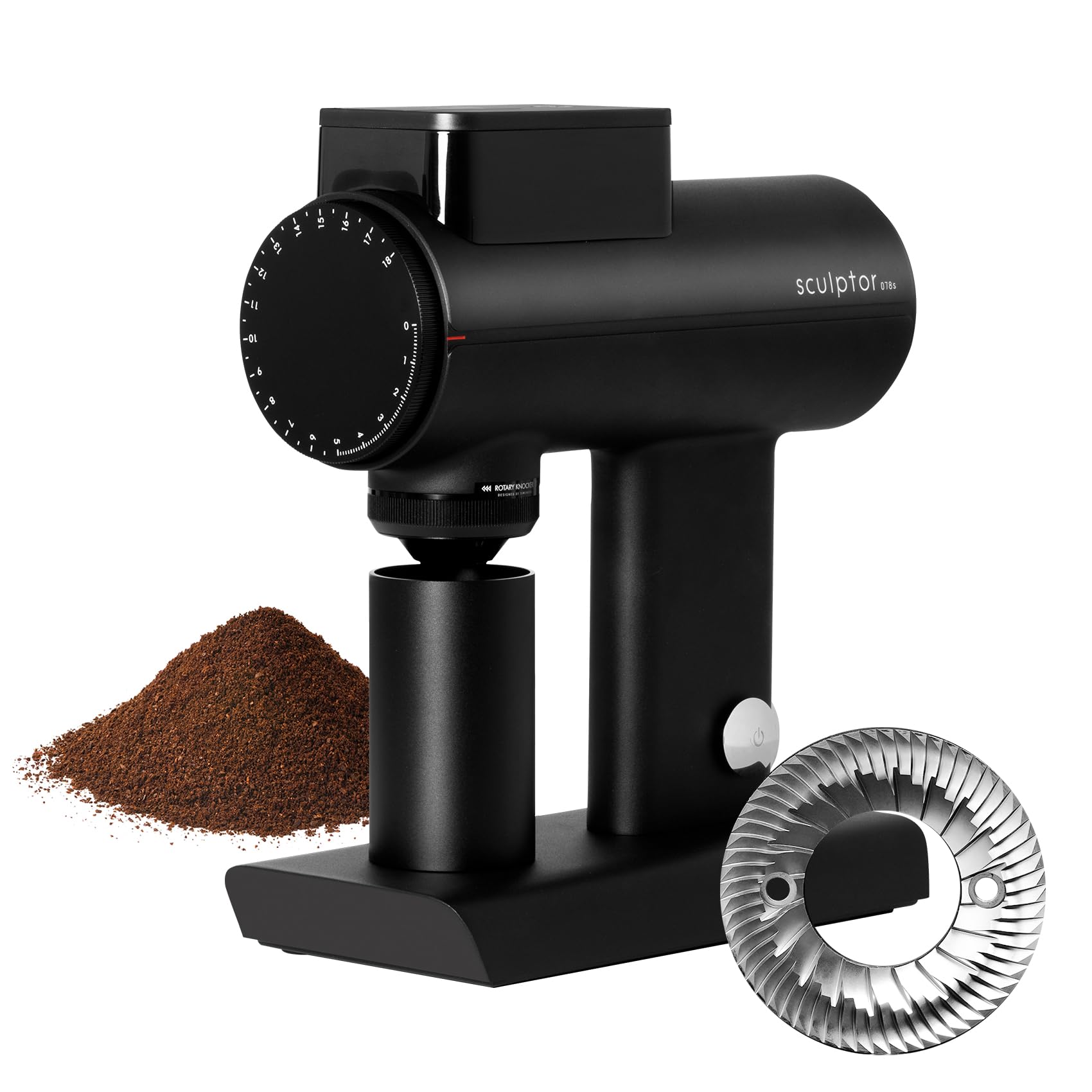
The 078S extends TIMEMORE’s Sculptor platform with 78mm flat burrs — the largest diameter in this comparison. Larger burrs mean faster grinding at lower RPM, less heat transfer to the coffee, and a wider sweet spot for extraction. The brushless motor with PID control and Hall sensors keeps the burrs spinning at a steady rate regardless of bean density.
The adjustable RPM range (800 to 1400) allows you to slow down for light-roast Nordic-style beans—reducing fines and improving clarity—or speed up for traditional medium-dark espresso. The rotary knocker is the same effective design as the 064S, and the magnetic alignment system on both the bean container and powder barrel ensures a centered grind path every time. The 19.5-inch height requires clearance under cabinets.
At this burr size, particle uniformity reaches a level that competes with commercial grinders. The tradeoff is the elevated price and the physical footprint. For home baristas who roast light and chase clarity, the 078S is a destination grinder.
Why it’s great
- 78mm flat burrs for exceptional particle uniformity
- Variable RPM for roast-specific optimization
- Brushless motor with PID stability
Good to know
- Larger footprint and tall 19.5-inch height
- Premium price matches prosumer performance
9. KINGrinder K6

The KINGrinder K6 is a manual hand grinder with a straight handle and a stainless steel conical burr set. The interior adjustment system delivers 16 microns per click with 60 clicks per full rotation, translating to 960 total positions — effectively stepless resolution for espresso dialing. The 25-35g hopper capacity suits single-dosing, and the full aluminum body with dual bearings ensures burr alignment stays consistent through years of use.
The catch cup design allows full disassembly by hand for brush cleaning, and the straight handle generates enough torque for light-roast beans without slipping. At 0.63 ounces, the unit is ultralight and packs flat for camping or travel. The external numbering ring makes grind size recall repeatable across brew methods.
For espresso, the K6 can grind fine enough to choke a machine, and the 16-micron step means you can dial in shot timing with precision that many entry-level electric grinders cannot match. The tradeoff is the physical effort: 30-45 seconds of hand cranking per double shot. If you value portability or want a manual backup, the K6 delivers electric-level consistency in a hand-powered format.
Why it’s great
- 16 micron per click adjustment for precise dialing
- Fully disassemblable for thorough cleaning
- Compact and portable for travel use
Good to know
- Manual grinding requires physical effort per dose
- Small capacity limits batch grinding
FAQ
Can I use a blade grinder for espresso at home?
How many grind settings do I need for espresso?
What retention level is acceptable for single-dosing espresso?
Do larger burrs always produce better espresso?
Final Thoughts: The Verdict
For most users, the grinder for espresso at home winner is the Eureka Mignon Specialita because it combines 55mm flat burrs, stepless adjustment, and sound insulation in a compact package that holds its setting between cleanings. If you want 64mm flat burrs and twin hopper flexibility at a mid-range price, grab the MOKKOM Professional 64mm. And for travel or manual precision, nothing beats the KINGrinder K6 with its 16-micron per click resolution.